

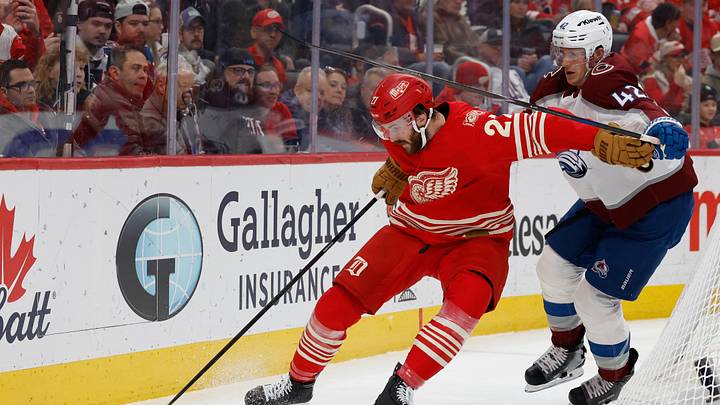
On Tuesday, June 30, the NHL's buyout window will officially open. The Detroit Red Wings have no shortage of candidates worthy of a buyout, but one stands above the others: Michael Rasmussen.
The former first round pick has done little, if any, to justify the four-year contract extension he signed back in 2024. Since the day of the deal (February 20, 2024), he's posted 45 points in 161 games.
That's an average of 22 points per season. Last year, Rasmussen's production stumbled to its lowest in years, ending the campaign with just 14 points in 64 games. If we take Rasmussen's $3.2M/year salary into account, the Red Wings paid Rasmussen $228,571.43 per point.
What if that money - and roster space - could be put to better use?
What if the Red Wings finally decided to buy out the former first round pick's contract?
The ramifications of buying out Rasmussen's contract
Buying out Rasmussen's contract would keep the Red Wings on the hook for his salary for four seasons, rather than the two remaining. That said, it spreads out his buyout cap hit in an era where the salary cap is rapidly expanding and the Red Wings have money to spare. Here's how the buyout would shake out:
Season | Savings | Cap hit |
|---|---|---|
2026-27 | $2,433,333 | $766,667 |
2027-28 | $2,433,333 | $766,667 |
2028-29 | -$1,216,667 | $1,216,667 |
2029-30 | -$1,216,667 | $1,216,667 |
From a salary standpoint, this move frees up a few extra million to keep depth players on the payroll (not that the Red Wings were in any sort of salary bind, of course). In a sense, it extends Justin Abdelkader's buyout by a few years. WIth that money having already been set aside for Abdelkader in years past, this seems like a very negligible move at best.
So what's the rationale in buying out Rasmussen rather than letting his contract play out? It comes down to one simple thing:
Roster spots.
The biggest benefit of buying out Michael Rasmussen
Due to the current roster construction, roster spots are few and far between. Buying out Rasmussen alleviates that problem, freeing up a spot on the bottom-six for a younger player to make their mark. As of right now, This is what the current forward lineup looks like (assuming Patrick Kane is extended):
Finnie-Larkin*-Raymond
DeBrincat-Copp-Kane
Mazur-Kasper-[empty]
Rasmussen-Compher-Appleton
*Dylan Larkin has requested a trade and will likely not be on the roster opening night.
Buying out Rasmussen opens up an extra spot on the roster for a player to make the leap. Assuming Michael Brandsegg-Nygard takes on the third line spot, a player like, say, Carter Bear could easily take Rasmussen's old spot. Then the Red Wings could move Mazur down to the fourth line and have an intriguging third line of Carter Bear, Marco Kasper and Michael Brandsegg-Nygard.
Two rookies and a player poised for a bounce back season could form the most exciting third line in the NHL.
Buying out Rasmussen gives the roster a chance to give more rookies a chance while allowing Rasmsusen a fresh start somewhere else. The 27-year-old will likely earn himself a short-term deal once he hits free agency, though it's unlikely the Red Wings could flip his contract without sending off picks in return.
 Add us as a preferred source on Google