

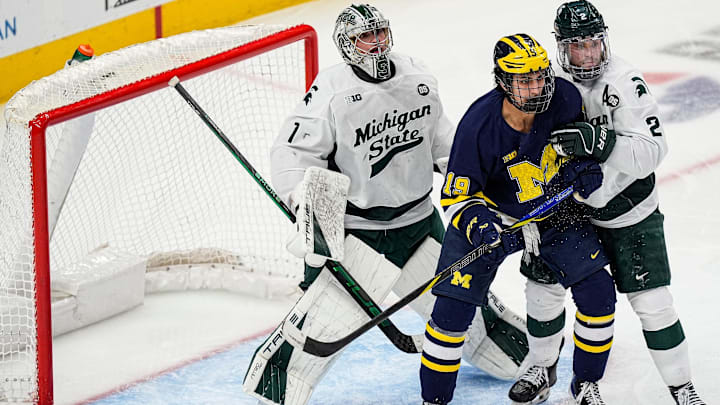
The Detroit Red Wings have a stacked goaltending pipeline. While Sebastian Cossa has deservedly drawn the spotlight for his athleticism and stellar play in Grand Rapids, Augustine’s game at Michigan State University has been a masterclass in predictability and poise. He’s not as explosive as Cossa, but he doesn’t need to be. Where Cossa overwhelms opponents with dynamic energy, Augustine disarms them with control.
If the Red Wings ever consider moving him, it must be for something significant. Teams don’t casually trade predictability in a position defined by chaos.
The calm behind the storm
At 6'1", Augustine isn’t the kind of netminder whose frame alone eats up shooting lanes. Instead, his value lies in an exceptional understanding of angles, depth, and edge control. His stance is compact but balanced: knees loaded, elbows tight, shoulders squared and blade edges light and reactive.
If you catch a game where Augustine is starting, you’ll see a goaltender who reads pace better than most of his peers. His movement isn’t reactive; it’s anticipatory. He thrives on taking half-ice away through micro-adjustments, a product of elite mechanics.
Many goaltenders at the NCAA level will overcommit to post plays or panic when pucks shift below the goal line. Augustine, by contrast, recovers seamlessly, using minimal effort to maintain visual tracking and structure. He combines positional economy with tactical mobility: a rare pairing that separates collegiate starters from professional-caliber goalies.
Michigan State’s anchor
It’s important to understand Augustine within the environment he plays. Michigan State is an excellent program — fast, skilled, and well-coached — but they allow more high-danger chances than their record would suggest. Their system thrives on transition, which sometimes exposes Augustine to odd-man rushes and lateral plays in tight.
That’s what makes his numbers so impressive. Augustin sports a .929 save percentage and 2.09 goals-against average this season despite consistently facing both volume and quality. The Spartans often rely on him to neutralize defensive lapses. Augustine consistently delivers.
Over his collegiate career, he’s shown steady, measurable improvement at every level:
- 2023–24 (NCAA, Michigan State): 35 GP, 2.96 GAA, .915 SV%, 3 shutouts, 23–9–2 record
- 2025–26 (NCAA, Michigan State): 30 GP, 2.08 GAA, .924 SV%, 3 shutouts, 19–7–4 record
- 2025–26 (NCAA, Michigan State): 30 GP, 2.09 GAA, .929 SV%, 3 shutouts, 22–7–1 record
That upward trajectory reflects both skill growth and refinement. He's a goaltender building on strengths, cleaning up details, and adding layers to his technical base. It’s part of what’s made him one of the most exciting prospects in college hockey.
What stands out on tape is that he doesn’t just stop pucks: he stabilizes games. When the pace ramps up, he’s still centered. When screens develop, he maintains his line of sight by peeking around bodies without overextending. His glove positioning remains high and active, and his post seals limit wraparound threats.
He has the athleticism to make the spectacular save, but he does it his way . He's controlled, compact and efficient. It’s a different kind of athleticism than Sebastian Cossa’s. Augustine doesn’t rely on raw explosiveness; his movements are built from repetition and geometry.
Rebound control, recovery, and reset
Rebound management is arguably the most translatable goaltending skill between levels, and it’s an area where Augustine excels. His ability to control the puck off his pads — absorbing shots when he can, steering them to low-danger zones when he can’t — is already professional-grade.
On tape, his stick work and pad angle discipline stand out. When shots come through traffic, he absorbs pucks into his body rather than swatting or deflecting them randomly. When he has to redirect, he uses blade angle rather than upper-body rotation, minimizing exposure and maintaining recovery positioning.
This consistency in second-save readiness is what scouts mean when they describe him as “predictable.” It's not that he's easy to read. It's that every motion has intention. His recoveries are compact, his head leads his movement, and his resets are immediate.
Composure under chaos
Augustine is what goalies call “quiet in the net.” When the puck enters his zone, his posture doesn’t change. He exhales into saves rather than tensing up. That calm translates. Teams with volatile systems need goalies who regulate tempo rather than amplify it, and Augustine’s presence stabilizes Michigan State’s high-risk, high-reward style. He communicates with his defenders through subtle stick taps and shoulder cues. It helps to create predictibility behind an otherwise unpredictable defense.
That steadiness is why his development curve feels more certain than most. It’s the same composure that’s been recognized within Detroit’s pipeline and locker room discussions.
The Askarov precedent
The Nashville Predators’ decision to trade Yaroslav Askarov to the San Jose Sharks sent ripples through the hockey world. Trading an elite goaltending prospect comes with high risk. Nashville did it from a position of depth, but, even then, the return must outweigh the risk.
Detroit now faces a similar philosophical challenge. The organization has two premium goaltending assets: Cossa, the high-ceiling showstopper, and Augustine, the technically elite stabilizer. Moving one is tempting if it fills a key roster hole, but recent history reminds us how thin that line can be. Given Gibson's age and injury history, keeping both may be more vital than treating depth as a luxury and therefore expendable. Gibson's season is proof of what this team is capable of with a steady performer in net.
While rumors will inevitably swirl around the deadline, Detroit’s management must remember that moving a goaltender like Augustine isn’t like trading any other prospect. His profile is built on technical consistency: a trait that's priceless in the net.
The path forward
When Augustine transitions to the professional level, likely signing with Detroit soon, questions revolve around speed, traffic handling, and post-play durability. But if there’s one thing that separates him from typical collegiate goaltenders, it’s how technically complete he already is.
His edgework gives him control over unpredictable rebounds. His glove placement and forward lean through his stance reduce net exposure on high shots. And his consistent posture, even in traffic, keeps him square even when chaos erupts around the crease.
Detroit’s goaltending department deserves credit for developing a clear philosophy: goalies who think first, move second. It’s what’s made Cossa’s game evolve and Augustine’s game thrive. And as seen in other player development success stories, patience unless for a needle-moving trade remains the Red Wings’ quiet advantage.
Final thoughts
Trey Augustine isn’t just another “good prospect.” He’s a prototype for where the position is going. He's smaller, smarter, calmer, and technically sharper than his predecessors. His predictability is his weapon. His calm is his edge.
Whether he becomes the future backbone of Detroit’s crease or the cornerstone piece in a major trade, his value is immense. If the Red Wings do move him, the return needs to be nothing short of fantastic.
Because even in a world where goalies are voodoo, Trey Augustine is as close to certain as it gets.
 Add us as a preferred source on Google