

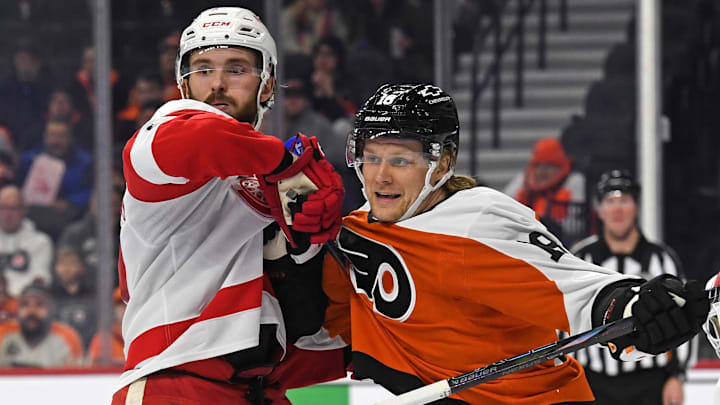
With the Olympic break coming to a close, NHL general managers are shifting their focus toward the trade deadline on March 6—a critical two-week stretch that will define the playoff push and set the stage for the offseason.
This is the time of year when bubble teams must make hard decisions. Do they double down and buy? Or do they accept reality and sell valuable assets for future building blocks? Perhaps no two teams needed this pause more than the Detroit Red Wings and the Philadelphia Flyers.
Two teams, two directions—one common need for Red Wings and Flyers
Detroit entered the break having lost four of its last five games and looked visibly fatigued from a condensed schedule. Yet, despite the slide, the Red Wings remain tied with the Montréal Canadiens for third in the Atlantic Division at 72 points.
The Flyers’ struggles were even more glaring. Philadelphia went 3–7 heading into the break and sits eight points back of both the New York Islanders (third in the Metro) and the Boston Bruins, who currently occupy the final wild card spot.
To make matters worse, the Flyers spent the final week before the break navigating off-ice distractions—head coach Rick Tocchet’s comments about Matvei Michkov’s conditioning sparked controversy, and GM Daniel Brière’s attempt to defuse the situation only fueled it further by comparing Michkov’s development to “raising a child.”
The next two weeks could determine whether Philadelphia chooses to push forward or retool once again.
Detroit's needs are well-documented
Detroit’s offensive struggles are no secret. The Red Wings sit 27th in the NHL in 5-on-5 goals, an alarming trend that has persisted despite the team’s overall progress this season. If Steve Yzerman decides to reward his players for their strong first half, adding a top-six forward seems like the most logical move—particularly one who can help generate secondary scoring and play at pace.
Enter Philadelphia
NHL.com’s Adam Kimelman, who has long covered the Flyers, reported that Detroit had two scouts in attendance for Philadelphia’s final game before the break against Washington. That’s a notable deployment of resources just before a critical evaluation window.
#ScoutsInTheHouse for Capitals-Flyers in Philadelphia: Red Wings (2), Rangers, Devils, Islanders, Avalanche, Blues, Panthers, Lightning, Senators, Maple Leafs, Blue Jackets, Jets, Blackhawks, Sharks, Penguins
— Adam Kimelman (@NHLAdamK) February 3, 2026
Who could the Wings be watching?
Despite being the name talked about most in connection with Philadelphia, Rasmus Ristolainen remains more of a depth consideration than a true top-four solution for Detroit, given his durability concerns and uneven play in recent seasons.
Another name that moves the needle a little more and makes sense for Detroit is Owen Tippett.
While not a center, Tippett would give Detroit something it currently lacks—size, speed, and a shoot-first mentality in its top six. The 6-foot-1, 210-pound winger is on pace for his fourth straight 20-goal season, sitting at 19 goals and 35 points through 56 games. Thirteen of those goals and 26 of those points have come at even strength, highlighting his ability to create offense in 5-on-5 play.
Locked into a long-term deal—six years remaining on an eight-year, $49 million contract signed in 2024—Tippett’s $6.2 million cap hit looks increasingly reasonable with the salary cap set to rise. At 27 years old, he’s entering his prime and could provide the kind of stable, middle-of-the-lineup production that helps teams transition from playoff hopefuls to true contenders.
Yes, Tippett wouldn’t come cheap. But compared to the astronomical prices for centers like Robert Thomas or Vincent Trocheck, he represents a more attainable upgrade with term attached.
Why would the Flyers even consider moving Tippett after committing to him long term?
The answer lies in their organizational depth on the wings. Philadelphia has a plethora of young wingers either in the NHL or on the cusp of arriving: Matvei Michkov, Travis Konecny, Tyson Foerster, Bobby Brink, Denver Barkey, Porter Martone, and Alex Bump. There’s even internal debate about whether Trevor Zegras, their second-leading scorer, is better suited to play on the wing.
With so many talented wingers competing for limited ice time, Brière could look to balance the roster by acquiring help in other areas—particularly in goal. It is no secret that Philadelphia has struggled to find a consistent answer since the much-publicized departure of Carter Hart due to off-ice incidents.
Detroit’s goalie depth is its leverage
Few NHL organizations are as well-positioned as Detroit when it comes to goaltending depth.
Sebastian Cossa has been outstanding in Grand Rapids, posting a 1.92 goals-against average, .930 save percentage, and a 22–4–2 record in 28 games.
Michal Postava, also with the Griffins, has quietly impressed in a backup role, going 9–3–0 with a 1.77 GAA and .936 save percentage across 14 appearances.
At the collegiate level, Trey Augustine has been brilliant for Michigan State University, with a 21–6–0 record, 1.96 GAA, and .933 save percentage over 27 starts.
In junior ranks, Rudy Guimond has backstopped Moncton to a dominant 32–5–2 record, boasting a 2.33 GAA and .922 save percentage, while Michal Pradel continues his steady play for Tri-City, posting a 2.48 GAA and .918 save percentage.
That organizational surplus makes Detroit a logical trade partner for a Flyers team still searching for stability in net following Carter Hart’s departure.
Balancing patience and urgency
If the Flyers continue to slide after the Olympic break, Daniel Brière could be forced to take a long look at the future of Flyers hockey—and moving a roster player like Tippett in exchange for goaltending depth and picks could accelerate their long-term stability.
From Detroit’s perspective, Yzerman faces an equally delicate decision. The team has shown enough promise to deserve reinforcement, but not enough consistency to justify mortgaging key future assets. Tippett, however, sits at the intersection of those two realities: a proven scorer entering his prime with a contract that fits the team’s competitive timeline.
The bottom line for the Red Wings and Flyers
The Flyers and Red Wings both find themselves at crossroads—one searching for stability, the other for a spark. A trade between them might just address both needs.
For Detroit, adding a player like Tippett—or even exploring a secondary piece like Rasmus Ristolainen to solidify the defence—could be the kind of measured, strategic push that propels them back into relevance. And for Philadelphia, leveraging their wing depth for long-term security in goal could be the pragmatic move that sets the foundation for a more balanced future.
As the deadline nears, both teams are standing on the same threshold—each hoping the next move they make is the one that finally changes their direction.
 Add us as a preferred source on Google