

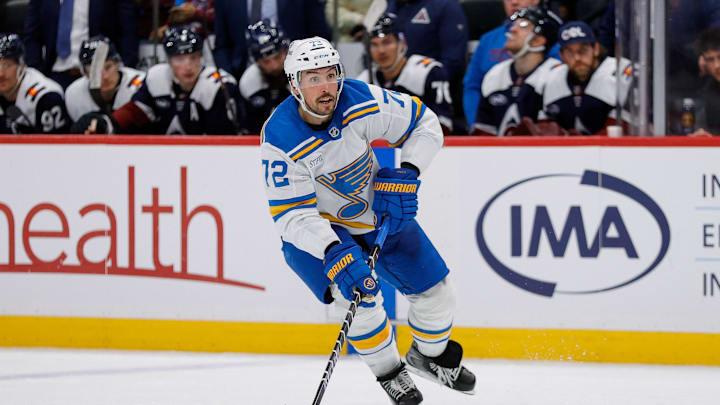
If the Detroit Red Wings are serious about taking the next step in what's been nearly a decade rebuild, the path forward is clear: stabilize the blue line with a legitimate, minutes-eating right-shot defenseman who can play in your top four—without sacrificing the long-term plan.
That’s where Justin Faulk fits. At 33, he’s not a high-risk acquisition, and he doesn’t need to be. He’s the type of add that helps you win the games you’re supposed to win, calms down the games that get chaotic, and lengthens your lineup in a way that matters in March and April. Plus, he's a reliable veteran player that comes with term; in other words, a very Steve Yzerman trade.
The perfect defenseman doesn't exist (well, he did exist, his name is Nick Lidstrom and he's retired). The Red Wings need reliability, structure, and the ability to manage matchups over 60 minutes. Faulk checks those boxes.
He gives head coach Todd McLellan options, and being able to trust the second pairing against the opponent's top line also allows the Red Wings to free up Moritz Seider at times and alleviate some of the pressure he shoulders on a nightly basis. Detroit’s blue line has talent. What it lacks—too often—is a steady right-side presence behind Moritz Seider, who can absorb quality minutes so the rest of the group can slot more naturally.
In 61 games this season, Faulk has produced 11 goals, 21 assists, and 32 points, while averaging over 22 minutes per night. That workload isn’t a one-off either—over a 15-year NHL career, he’s consistently lived in that 21–23 minute range. Coaches trust him to take hard minutes, play special teams, and survive in the kind of game states that expose weaker defensemen who can feel like they're in over their heads at times.
The underlying results support the idea that there’s still real utility here. His Corsi For Percentage (47.4) sits slightly below average, but context matters—he’s playing on a Blues team that hasn’t exactly been a possession machine. Despite that environment, he’s posted a +2.9 Expected +/- on the year, which speaks to a player who can still tilt outcomes in the right direction.
The Yzerman–Armstrong connection matters
Making a trade this time of year can be difficult. There are aggressive general managers, and then there is Steve Yzerman. Yzerman simply won't overpay. There has been a flurry of deals lately, with Friday's 3 p.m. EST deadline quickly approaching, and the Red Wings have yet to take part. Yzerman might simply be waiting for the market to settle, with asking prices beginning to drop slightly as the deadline gets closer. Ironically, there are plenty of players still available, and Yzerman will be able to add a defenseman; plus, there are still plenty of options to bolster the group of forwards.
When it comes to this time of year, personal relationships matter. Yzerman and St. Louis Blues general manager Doug Armstrong have established a professional friendship built on practical, mutually beneficial transactions.
The two organizations have already found common ground on multiple deals, including trades involving Robby Fabbri, Ville Husso, and Jakub Vrana. Those moves didn’t happen by accident. They showed a collaborative rapport: both sides could negotiate without posturing, identify a fit, and close a deal aligned with each club’s objectives.
When you’re trying to make a meaningful hockey trade—not a deadline panic buy—history like that matters.
Faulk also aligns with how Yzerman typically operates. He has one year remaining on his deal at $6.5 million AAV, and we all know how much Yzerman values adding players with term rather than paying full price for a rental.
In closing, Justin Faulk checks all the boxes the Red Wings should be prioritizing: right-shot, top-four capable, plays big minutes, adds offense without cheating defense, and comes with term. The term gives you options: you’re not forced into a desperate re-signing, and you’re not watching your asset walk in July. You’re buying stability now and flexibility later.
 Add us as a preferred source on Google