

With the NHL Trade Deadline just two days away, the Detroit Red Wings have a clear priority: adding a legitimate second-line center who can stabilize the middle of the lineup behind Dylan Larkin. (I feel like I've been writing that same line since at least 2020.)
Whether the Red Wings want reliable two-way minutes, special teams versatility, or a swing-for-the-fences type of player, there are several forwards who would fit.
These are the top four targets general manager Steve Yzerman needs to prioritize adding. My list focuses on on-ice impact, fit, and the practical realities of age and contract. You might notice a trend: not only are these players two-way players, but all come with term, something Steve Yzerman has prioritized in trade talks.
4. Nazem Kadri is the postseason pest the Red Wings need
Nazem Kadri remains one of the league’s most effective “pest with purpose”—an experienced, competitive center. At 35, Kadri has totaled 12 goals and 41 points this season on a struggling Calgary Flames roster while still handling heavy usage, averaging over 19 minutes per night.
In Detroit, he’ll slide nicely into the second-line center role behind Larkin, providing structure down the middle and a steady two-way presence that can be trusted in all situations.
Kadri’s value is that he can help you win shifts at five-on-five, contribute on the penalty kill and add enough creativity to operate on a second power-play unit without forcing the offense. His underlying even-strength numbers are solid given team context: a 51.7 Corsi For Percentage and a +1.8 Relative Corsi For. The drawbacks are obvious and significant: he’s 35, sits at 48% in the faceoff circle and is under contract for three more years after this season at $7 million annually. The player fits; the term is the gamble.
3. Elias Pettersson has the most offensive upside of this group
Among this group, Elias Pettersson has the highest ceiling — and the widest range of outcomes. The former point-per-game center looks like a player who could benefit from a true reset after recent years in Vancouver, where his confidence and role have been questioned amid reported tension and uncertainty.
Still, the talent is undeniable. Pettersson is 27 years old, and even in a down season he’s produced 13 goals and 35 points in 52 games—well below the standard he set in 2022–23, when he erupted for 102 points (39 goals, 63 assists), then followed it with a 34-goal, 89-point campaign.
That drop-off is exactly why he’s intriguing: if Detroit believes it can rebuild the player, the payoff is massive. As far as fit goes, Pettersson’s two-way lean makes him a natural second-line center option, with the versatility to play between high-skill wingers like Patrick Kane and Alex DeBrincat while still handling hard minutes.
The contract is the hurdle: he’s in the second year of an eight-year deal at $11.6 million per season. It’s a difficult number, but you’re paying for a potential star — one that may simply need the right environment.
2. Vincent Trocheck is dominating the faceoff circle
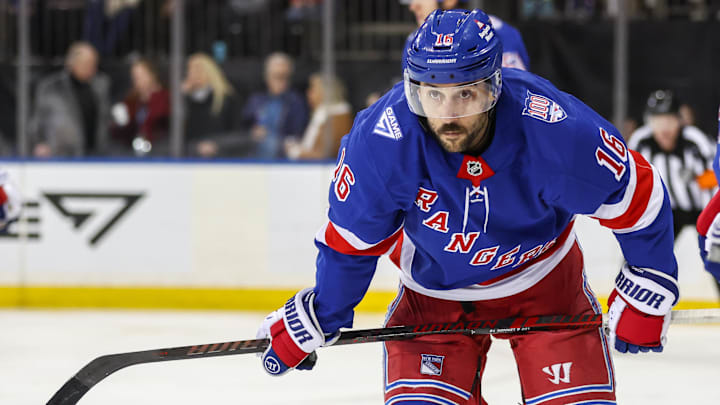
Vincent Trocheck checks nearly every box for a team trying to win games in April. Fresh off an Olympic gold medal and reportedly available from a rebuilding New York Rangers club, the 32-year-old plays a complete, detail-oriented game and brings legitimate value in all three zones; something Steve Yzerman desires.
Like Kadri, he can be used in every situation - power play, penalty kill, and tough five-on-five matchups - without your lineup feeling like it has to be “protected.” For Detroit, Trocheck’s appeal is straightforward: he’s a ready-made second-line center who adds edge, tempo, and structure, while still providing offense.
This season he has 12 goals and 39 points in 46 games, and he’s averaging a touch over 20 minutes per night, illustrating both trust and workload. His possession profile is steady (51.5 Corsi For Percentage), and his 57% faceoff success rate is a playoff-style advantage that can swing special teams and late-game sequences.
Contractually, he’s in the fourth year of a seven-year deal at $5.6 million annually: more manageable than other big-ticket options, but still a commitment. If Detroit wants the “safest” impact center on this list, Trocheck is the one.
1. Robert Thomas, in the prime of his career can bring a much-needed jolt to the Red Wings
Robert Thomas is the swing that could change Detroit’s lineup for years, not just months. At 26, he’s entering the prime of his career, and his blend of intelligence, puck skill, and two-way reliability is exactly what teams chase when building a contender down the middle.
The fit is also helped by the history between Detroit GM Steve Yzerman and St. Louis GM Doug Armstrong—relationships don’t guarantee deals, but they can open doors other teams can’t.
Even with injuries slowing him at times this season, Thomas has 12 goals and 35 points in 43 games, and he remains a strong all-around center with a 52.4% faceoff success rate. The bigger selling point is his trajectory: he’s coming off back-to-back seasons with 20-plus goals and 80-plus points, and that type of production, paired with responsible play away from the puck, is rare.
In Detroit, Thomas would immediately solidify the second line and give the Red Wings the kind of one-two punch at center that can survive playoff matchups. He’s the most impactful add here because he isn’t just a deadline rental-type solution: he’s a foundational piece.
 Add us as a preferred source on Google