

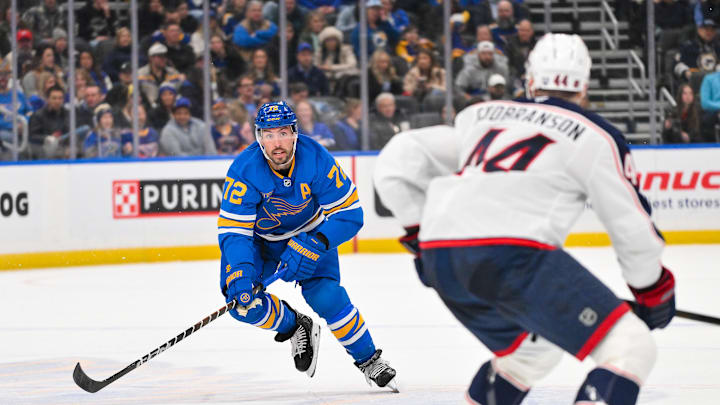
Minutes before the March 6th trade deadline, the Detroit Red Wings made a splash by adding defenseman Justin Faulk via a trade with the St. Louis Blues. To acquire Faulk’s services, the Red Wings shipped off their 2026 first-round pick, 2026 third-round pick, defenseman Justin Holl and prospect forward Dmitri Buchelnikov. Losing Buchelnikov stings, but was the cost of doing business here.a
A 15-year veteran who debuted at age 19 with the Carolina Hurricanes during the 2011-12 season, Faulk has logged 1,041 NHL games on defense in his time split between Carolina and St. Louis. This season, he has scored 11 goals and added 21 assists for 32 points while averaging 22:30 time on ice per game in 61 games. This is the seventh time in his career he has scored at least 11 goals. He also represents a player who is no mere rental as he is signed for next season as well.
Faulk is expected to make his Detroit Red Wings’ debut in Sunday’s road tilt against the New Jersey Devils. What can Detroit fans expect when he roams their blue line as he helps the team push toward the playoffs this year and next?
Faulk brings consistency, stability and durability
Justin Faulk has been a fixture for his team’s blue line since leaving Minnesota Duluth (following a national championship victory) after his freshman season. He stepped straight into the lineup for the Hurricanes by averaging 22:51 on ice over 66 games.
In over 1,000 NHL games, Faulk has averaged 22:58 on ice. In his first six seasons with the Blues, he helped them make the playoffs four times. While his peak offensive years of 47 points and 50 points in the 2021-22 and 2022-23 seasons are likely behind him, he has posted 30 or more points five years in a row and 11 times in his career.
For a Red Wings’ blue line whose depth got exposed a bit when Simon Edvinsson went down with an injury shortly before the Olympic break, Faulk adds durability with his depth. He logged 76 or more games in three of his past four seasons and is on pace to do so again this year. The rigor of an NHL season doesn't wear him down. Faulk has cleared 70 games played in eight of his 15 seasons, and that doesn’t include seasons that were shortened by a lockout (2012-13) or a global pandemic (2019-20 and 2020-21). That type of consistency is hard to find on defense, hence the price Detroit paid.

Justin Faulk adds a top-four defender track record
With over 1,000 games under his belt and still leading his former team in average time on ice, Faulk is an established top-four defender. Perhaps miscast at this point as St. Louis’ number one defenseman, Faulk easily slots in as a second-pairing guy in Detroit, where the Red Wings have struggled to fill out that number four slot outside of Moritz Seider (25:40 ATOI), Simon Edvinsson (22:37 ATOI) and Ben Chiarot (21:09) as none of the team’s other defensemen average more than Axel Sandin-Pellikka’s 16:20 time on ice per game.
Over the course of his career, Faulk has more than held his own as a team’s number one defender. However, his 47.7% Corsi (albeit a +0.7 relative Corsi) score this season makes that role likely a thing of the past. What he does provide is someone you can feel comfortable on the ice in all situations to take some of the load off Seider and keep him fresh for what should be his first playoff appearance.
With Faulk around, the Red Wings can comfortably deploy him on the penalty kill and on the second power play unit along with close games late in the third period. While Seider should still command the lion’s share of the minutes on this defense, if Faulk manages to shave even a minute off Seider’s ice time down the stretch, that is a massive win for the Red Wings. Given his established consistency, that is a real possibility.

Faulk buys Axel Sandin-Pellikka development time
For a first season in North America, Axel Sandin-Pellikka’s rookie year has been impressive. He has logged 61 games and posted 19 points on six goals and 13 assists, despite limited minutes and not playing on the team’s top power play unit. However, the season is wearing on him and some of his rookie mistakes are earning him more time on the bench than on the ice.
Here’s a look at ASP’s ice time per month:
October | 18:43 |
|---|---|
November | 19:05 |
December | 16:01 |
January | 13:36 |
February | 13:44 |
March | 12:16 |
Since posting nine points in 15 December games, ASP’s time on ice has plummeted, and would even further without averaging over a minute per game of power play time on the second unit. It is still valid to be high on his long term potential, I certainly still am, but there are enough warts in his defensive game that head coach Todd McLellan has played him for under 13 minutes in 11 of the Red Wings’ last 23 games going back to Dec. 31.
For all of that upside, Faulk right now offers stability that Axel Sandin-Pellikka is lacking. That extra year on Faulk’s contract allows Detroit the ability to pencil him in as a top-four defenseman next year. It might even buy more developmental time for ASP, who could benefit from an AHL stint as the Grand Rapids Griffins’ top defender now that they've shed Justin Holl in this deal.
Faulk checks all the boxes the team needs: he's a reliable puck movement with some offense and responsible defense that will earn him McLellan’s trust. It's safe to assume that Sandin-Pellikka will be a factor as a top-four defender for the team and potentially quarterbacking the team’s top power play unit, but that time is clearly not now. Having Faulk around that extra year as he likely declines a little further allows Detroit to give ASP room to grow, which is one of the biggest wins in this deal.
At this point in his career, Faulk is best suited to be a team’s third or fourth defenseman, perhaps even a third-pairing guy on a deeper blue line than Detroit has. Ideally, Sandin-Pellikka takes a step forward next year to become that reliable second-pairing defenseman who contributes offensively and approaches 20 minutes per game as Faulk approaches the end of his deal in 2027.

Justin Faulk provides Red Wings flexibility
Moritz Seider and Simon Edvinsson have been an elite shutdown pairing when together this season, but putting those two on the ice at the same time means spending 35 minutes without either on the ice. With Faulk, the Red Wings have the luxury to deploy their top guys together regularly without worrying about the drop-off when they’re catching their breath between shifts.
If Faulk has been serving as a top defenseman, it stands to reason he can be the lead defender on a second pairing, should Todd McLellan keep his lockdown top pairing together. If so, Faulk could play alongside Chiarot in a role that requires fewer tough matchups than when he is with Seider.
Alternatively, McLellan could continue using Seider to shelter Chiarot on the top pair and put Edvinsson with Faulk, which would cover roughly 45 defensive minutes per game. That would leave the trio of Jacob Bernard-Docker, Albert Johansson and Axel Sandin Pellikka (or Travis Hamonic if Sandin Pellikka is sent down to play top minutes in Grand Rapids) to account for the other 15 minutes, which is not a tall ask for this group.
The Justin Faulk trade is a show of faith by Steve Yzerman in this improving group to finally deliver a long awaited playoff appearance. Despite Friday’s regulation loss to Florida (and depending on when/how Dylan Larkin recovers from a pretty bad looking injury late in the contest), the Red Wings are a good bet to make their first postseason appearance since 2016. With Faulk in tow, the Red Wings added a much-needed heavy minute defenseman, one who can also chip in offensively at even strength and the power play that is a picture of durability. In other words, this move is exactly what the Red Wings desperately need.
 Add us as a preferred source on Google