

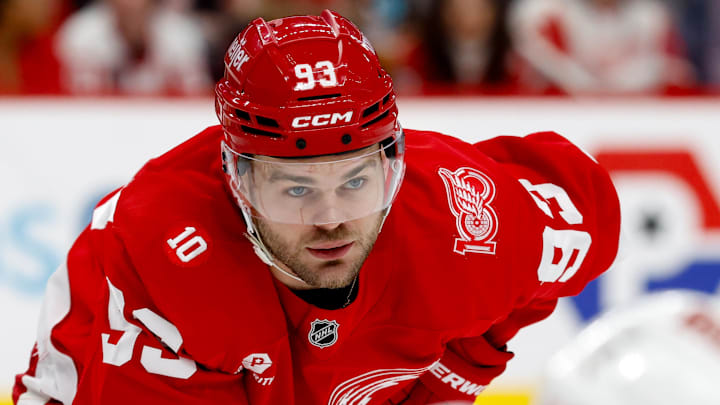
What if the current iteration of the Red Wings just isn't working anymore?
Since 2022, general manager Steve Yzerman has shopped the free agent market and made several trades aimed to bolster a core that includes captain Dylan Larkin, former Calder winner Moritz Seider and productive wingers Lucas Raymond and Alex DeBrincat into postseason play. Despite setbacks, there have been progress and several near-misses with the playoffs.
It is tempting to think only minor tweaks are necessary for this team to get over the hump. After all, three of Detroit’s top four skaters are locked up on long-term deals that are very cap friendly, with only Dylan Larkin’s $8.7 million figure going above $8.55 million annually against the cap. That flexibility could also fit a big contract should the Red Wings elect more drastic measures such as trading for an impact player.
If this core isn't cutting it, what if it's best to just start fresh?

Why it's time to move on with this core
Detroit’s in a weird situation with the aforementioned core four of Larkin, Seider, DeBrincat and Raymond. While three of those four are signed until at least 2031, only Seider and Raymond are 25 or younger. Larkin turns 30 next season and while still productive, is more likely than not to be entering the downward half of his career. DeBrincat turns 29 and is entering the final year of his four-year deal.
With a rising salary cap, DeBrincat will almost certainly make a sizeable amount more than his current $7.875 million cap hit. Any team bidding for his services next summer likely has to commit six years and over $10 million annually.
With Larkin and DeBrincat leaving their peak production seasons, the need to commit big term and money to keep DeBrincat past next season and a farm system that is short on impact offensive talent, this group has extremely limited upside. When you throw in the fact that the unrestricted free agent market is generally short on difference-makers, the picture for making a leap forward is pretty bleak.

Why the Red Wings should trade Larkin and DeBrincat this summer
Despite trading for Justin Faulk to break the playoff drought, the Red Wings, yet again, failed to make the playoffs. While nobody is going to deal the top pick that could get potential franchise winger Gavin McKenna, a player like Dylan Larkin still has value on the trade market. Despite yet again scoring over 30 goals and nearly hitting 70 points, Larkin's drop in 5-on-5 scoring may make him a prime candidate for further regression as he hits his age 30 season.
Larkin's (potential) suitors
If the Red Wings hope to trade Larkin, a familliar face might be just what he needs. The Los Angeles Kings are watching Anze Kopitar's final games. They'll be in need of a top-line center before they know it. Former Red Wings general manager Ken Holland runs the show out in LA. By acquiring Artemi Panarin, he's signaled to the team he has no interest in initiating a rebuild.
An up-and-coming team like the San Jose Sharks might view Larkin as a finishing piece to their rebuild. He could easily slot in as the Sharks' second-line center behind burgeoning superstar Macklin Celebrini. Any way you slice it, the Red Wings would have no shortage of suitors for their captain (should they make him available). Trading Larkin gives the team a chance to obtain at least a first round pick and a young player with upside (think Quinton Byfield from the Kings for example).
Where DeBrincat can find a new home
Alex DeBrincat has been exactly what the Red Wings hoped for when they traded for him from Ottawa. This year’s 41 goals made him Detroit’s first 40-goal scorer since Marian Hossa in 2008-09 and marked the third 40-goal season of his career. That type of offense is valuable to anyone in the NHL and any contending team looking to bolster their lineup will pay handsomely to do so. There's certainly an argument for bringing him to training camp and trading him at the deadline. But the problem with that is if you are trying to rebuild, DeBrincat’s presence would actively hurt your chances at winning the Landon DuPont sweepstakes in 2027.
The Red Wings can likely name their price on DeBrincat and should be able to fetch another first-round pick along with a useful young prospect or young regular. A lineup without Larkin and DeBrincat is definitely taking a step back in 2026-27 contention. Having said that, if they were to get Landon DuPont with him making anywhere close to the impact Matthew Schaefer did for the Islanders this year, that’s a defense core that could be in business.
Speaking of which...

Detroit should shop Simon Edvinsson
This part is tricky as Edvinsson has ideal size, strong skating and above average offensive instincts to be a number one defenseman. He has meshed well with Seider and, with better health, could easily be viewed as a second number one defender that allows the Red Wings to ice a dominant shutdown defender for 2/3 of the game if they split him and Seider up.
That said, Seider is clearly the number one defenseman and is anchoring the power play for the time being, with Axel Sandin Pellikka (more on him later) the next in line to be the point man on the power play. Despite getting minimal power play time, Edvinsson’s point totals of 31 and 25 points the past two seasons is solid and his size make him an ideal candidate to log heavy minutes on a top pairing with most NHL teams.
With Edvinsson entering restricted free agency, he is going to command a sizable pay raise from last year’s $894K cap hit to a minimum of $7 million per year. That’s a figure the Red Wings can comfortably fit in their cap, but it could also be an asset that helps them further cash in for young talent to a team looking to make a more immediate jump forward (San Jose again comes to mind and may be willing to part ways with a Sam Dickinson in such a deal).

The prospects need to play
In this blow it up scenario, the prospects need to stop being theoretical players who could help and become actual NHL players who are proving they can be productive at the sport’s highest level. Players like Michael Brandsegg-Nygard, Carter Bear, Carter Mazur, Nate Danielson and many others need a path to actual NHL minutes this season so Detroit can decide who is worth keeping around. Every contract for a 30-year-old plus player needs to be for a purpose.
With John Gibson getting hung out to dry in a rebuild scenario and facing an expiring contract of his own, trading him gives both Sebastian Cossa and Trey Augustine the opportunity to establish themselves as an NHL tandem. Admittedly, their work will be cut out for them, but Detroit gets the opportunity to plant their flag on their goaltending prospects and figure out what they have in the crease. After his resurgent season, Gibson should also fetch more than what Detroit sent for him to the right contender (cough, Edmonton, cough).

 Add us as a preferred source on Google