

The 2026 NHL playoffs don’t involve the Detroit Red Wings, just as the playoffs before that, and before that, and before that, and so on all the way back to 2017. This is the third straight year this team entered March holding a playoff spot only to clean their locker rooms out after game 82. At this point, it is reasonable to question the validity of general manager Steve Yzerman’s vision for rebuilding the franchise he starred for on the ice for two decades.
Despite solid individual seasons from players like Alex DeBrincat, Moritz Seider and Lucas Raymond, it was not enough to get the Red Wings into the dance. The biggest issues were their lack of production at 5-on-5 and a key difference-maker at the second-line center.
After clearing 90 points twice in the past three seasons (with 86 points in the other one), it may be tempting to simply build at the margins and hope for better results with a farm system that is starting to yield talent. However if the goal is to compete for more than a first-round exit, this would be a mistake. This alternate path explores a bolder, fresher approach.

Yzerman must hunt for impact talent
With a core four that were all under 30 this year (though Larkin will be 30 next season), there is reason to believe that the output of Larkin, Seider, DeBrincat and Raymond should remain stable barring injury. However, years of shopping for end of roster upgrades hasn’t proven enough to supplement that group and get them into the postseason. Since the unrestricted free agent market generally doesn’t yield needle-moving talent, it’s time to look at the trade market.
Detroit’s problem is something of an inverse to the perpetual Stanley Cup runner-up Edmonton Oilers. Where the Oilers have generational talents in Connor McDavid and Leon Draisaitl putting up gaudy point totals and dragging the team to relevance, they have struggled to find enough quality depth to get them over the hump. Still, that duo along with the production of Evan Bouchard consistently puts them in the playoffs.
Detroit, on the other hand, has the type of middle-to-end of roster talent in spades in their farm system. There's reason to believe folks like Axel Sandin Pellikka, Michael Brandsegg-Nygard, Carter Bear and Nate Danielson can put up respectable performances on their entry-level and pre-UFA contracts to create cost stability on a roster with a sufficiently good core.
Despite a good quantity of useful players in their farm system, the Red Wings are in a spot where they need players who are as good as or better than their best players now. Impact talent is hard to move, but it does happen; we’ve seen Mikko Rantanen change teams twice, Quinn Hughes get dealt this year and Jack Eichel also get moved after undergoing surgery while with Buffalo.
Let’s look at the makeup of those deals before we move onto the Red Wings’ farm system.
Eichel trade
Vegas gets: Jack Eichel, Buffalo 2023 third round pick
Buffalo gets: Alex Tuch, Peyton Krebs, 2022 first round pick, 2023 second round pick
Rantanen trades
Carolina gets: Mikko Rantanen and Taylor Hall (from Chicago)
Colorado gets: Martin Necas, Jack Drury, 2025 second round pick, 2026 fourth round pick
Chicago gets: 50% Mikko Rantanen salary, 2025 third round pick
Dallas gets: Mikko Rantanen
Carolina gets: Logan Stankoven, 2026 first round pick, 2028 first round pick, 2026 third round pick, 2027 third round pick
Hughes trade
Minnesota gets: Quinn Hughes
Vancouver gets: Marco Rossi, Liam Ohgren, Zeev Buium, 2026 first round pick
All of these trades involved lineup regulars, top prospects in the organization at the time and high draft picks. Besides the brief standstill Carolina reached during Mikko Rantanen’s brief cameo with the Hurricanes, the team that got the best player would make the deal again multiple times over. While it sounds like Detroit was inches away from landing Hughes in a blockbuster trade, Minnesota is reaping the benefits for being willing to roll the dice on retaining him after next season. This is the framework of what dealing for impact talent looks like.

Make the farm system help one way or another
Asking for the bulk of Detroit’s top prospects (many of whom have limited NHL experience) to push them into the playoffs next year is still a tall order. The point of prospects is to make your team better -- not to carry the team. While the Red Wings’ treasure chest has been loaded high-end prospects for a while, they can also help as pieces to big swing trades.
Despite the high marks Detroit’s farm system receives from experts, none of them seem poised to challenge for first line or first pairing minutes. The general consensus of guys like Nate Danielson, Michael Brandsegg-Nygard, Max Plante, Nate Danielson and Axel Sandin Pellikka are that of useful middle-six forwards or second-pairing defenders. Those have value if your core is good enough to drive you forward, but that doesn’t appear to be the case for the Red Wings.
Red Wings need a top center
Despite providing a lift and some stability at points over his contract, Andrew Copp is not any contending team’s ideal second-line center. With Marco Kasper having a sophomore slump and Compher dropping off precipitously throughout his contract, Copp slid in at 2C out of necessity. Having said that, Copp has only one 50-point season in his career. That just isn’t enough out of someone expected to play that type of role. The last time Detroit had two centers clear 50 points in a season was when Henrik Zetterberg notched 56 points in 63 games in 2017-18.
A high-end difference-maker that insiders link to Detroit could be a huge boon for this team. Vancouver Canucks forward Elias Pettersson is up for grabs -- he makes perfect sense for the Red Wings. There was also word that Detroit kicked the tires on Vincent Trocheck, but Yzerman was unwilling to meet the Rangers’ asking price.
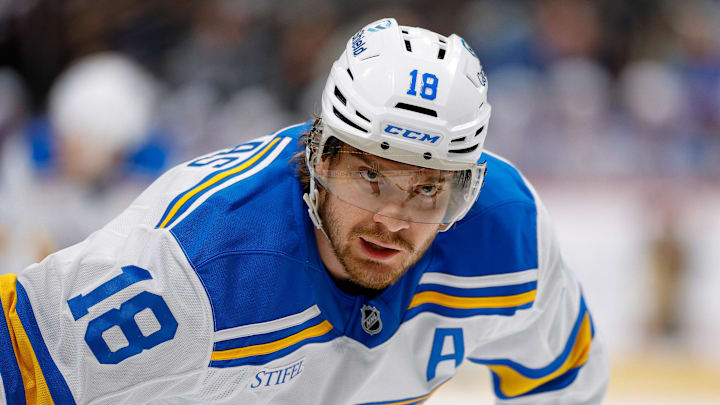
The biggest center name on the market this last trade deadline was Robert Thomas, who represents a massive upgrade to Detroit’s lineup. The St. Louis Blues' asking price is justifiably high and St. Louis may opt to hang onto him to see if they can get back to the playoffs next season, but he is someone who makes a lot of sense.
For any deal to happen, Detroit has to be comfortable dealing any combination that includes the following:
- 2027 First Round Pick (and 2028 if need be)
- Michael Brandsegg-Nygard
- Carter Bear
- Nate Danielson
- Axel Sandin Pellikka
- Anton Johansson
- Marco Kasper
- Sebastian Cossa
- Trey Augustine
- Max Plante
That isn’t to say Detroit needs to empty the tank and deal all of these players, but the asking price wil likely require a combination of picks and prospects to make it happen. If Detroit is serious about improving their roster, the team can’t just add on the margins. Trading for top end talent requires moving big name prospects and young roster players.
Here’s how a potential deal looks for each of the three names mentioned:
- Detroit gets: Robert Thomas
- St. Louis gets: Sebastian Cossa OR Trey Augustine, Carter Bear OR Michael Brandsegg-Nygard, 2027 first round pick, Nate Danielson OR Marco Kasper
- Detroit gets: Elias Pettersson
- Vancouver gets: Sebastian Cossa OR Trey Augustine, Nate Danielson OR Marco Kasper, 2027 first round pick OR Michael Brandsegg Nygard
- Detroit gets: Vincent Trocheck
- New York gets: 2027 first round pick, Nate Danielson OR Marco Kasper, Anton Johansson
I’m operating on the framework that Robert Thomas is currently valued at the equivalent of four first round picks, Pettersson at three first round picks and Trocheck at between two and three first rounders. Either of Detroit’s goalie prospects at present value meets that criteria, Bear and Brandsegg-Nygard were the team’s last two first round picks. Kasper and Danielson both have NHL time under their belts.
Additionally, Bear and MBN are similar players, Kasper and Danielson are both second-line center hopefuls and Cossa and Augustine are battling it out to be Detroit’s goalie of the future. The Red Wings have redundancies at those spots and will have to choose who they want to hitch their wagon to in a trade. Depending on who they were to pursue, they could also potentially get another player in a trade later, such as seeing if Adam Fox would join in with Trocheck on a potential deal with the Rangers.
Ultimately, the Red Wings have a need for impact talent, that talent is available for trade, and Detroit has the pieces to make a trade happen. Doing the same thing again and again by slightly tweaking this roster and hoping for better results is the literal definition of insanity.
It’s time for Yzerman to cash in his prospects to make the team a playoff contender.
 Add us as a preferred source on Google