

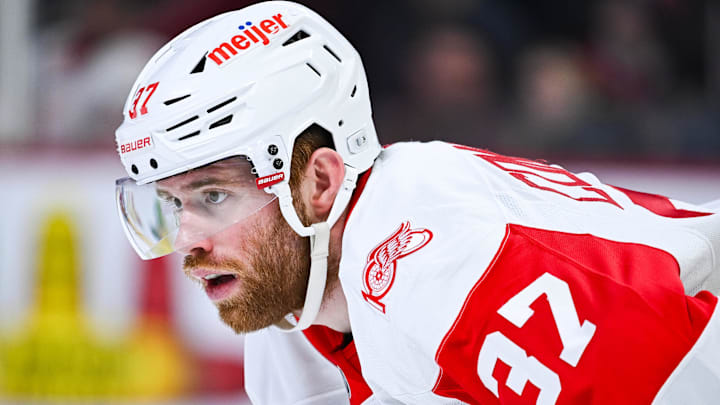
The Detroit Red Wings are once again flirting with the kind of late-season fade that has haunted them in recent years. They still control their destiny, sitting at 79 points and holding the first Wild Card spot in the Eastern Conference, but the margin for error is shrinking by the day.
Boston is just one point back in the second Wild Card position, Columbus is charging from the outside with 76 points, and even Ottawa (73 points) remains within binocular distance. If Detroit wants to lock up a playoff berth for the first time in nearly a decade, it can’t rely solely on its top-end talent -- especially now that they're short two centers.
The Red Wings need more from the middle and bottom of the lineup, and if that doesn’t arrive soon, there’s a legitimate question of how many of these roster spots should be protected heading into the offseason.
The Red Wings don’t need perfection from their depth players, although that would be nice, but they do need contributions—whether that’s timely scoring, consistent puck management, or simply pushing play in the right direction. With Boston, Columbus and Ottawa all close enough to apply real pressure, another March collapse would be more than a disappointment. It would be an indictment of roster construction and internal development. Sorry, but it's the truth.
J.T. Compher's days as a Red Wing may be numbered
J.T. Compher, 30, is trending toward another underwhelming year in Detroit with just eight goals and 20 points through 65 games. The bigger issue is that the production has dried up as the games have become more meaningful, with four goals and 11 points over his past 40 games. He has just one goal since January 24th.
Even when Compher isn’t scoring, you’d like to see him tilt the ice, but the underlying numbers paint a similar picture. He owns the second-worst Corsi For Percentage among Red Wings forwards (45.4%), with a Relative Corsi For Percentage of -4.5. This indicates that Detroit controls less of the shot attempt share with him on the ice than without him.
That simply isn’t enough for a player earning $5.1 million annually. Compher is in year three of a five-year deal, and if he can’t provide tangible value down the stretch, Steve Yzerman should explore options this summer. It likely wouldn’t be an easy sell on the trade market, but a team looking for a bottom-six forward might bite if Detroit retains a portion of the salary. This move would also open a full-time roster spot for a younger, developing forward such as Nate Danielson.
Michael Rasmussen has failed to even come close to producing like a top-ten pick should
Michael Rasmussen’s frustration is a different kind. At his size, the expectation is that he can create a hard area advantage and win those 50/50 wall battles, extend possessions, and make life miserable for opposing defenders. Instead, too many of his shifts end with Detroit losing a board battle they should be winning. That disconnect between frame and impact has followed him throughout his tenure with the Red Wings. I haven't seen a player of his stature play as small as he does at times for the Red Wings since Jonathan Ericsson.
Now in year seven after being selected ninth overall, Rasmussen still hasn’t come close to matching the role that pick implies. This season, he has six goals and 14 points in 60 games. Woof.
The underlying numbers reinforce the eye test: Rasmussen ranks last among regular Red Wings forwards in Corsi For Percentage (45.0%). The scoring drought is glaring; he hasn’t recorded a point in his last 21 games. For a player in year two of a four-year contract that carries a $3.2 million average annual value, that’s a problem Detroit can’t keep absorbing if it wants to take the next step.
If Rasmussen can’t find a way to impact games over this final stretch when the Red Wings are desperately in need of a hero, it wouldn’t be surprising if he’s wearing a different jersey next season.
Rasmussen's spot could be better used on a younger player with a clearer identity. Michael Brandsegg-Nygard, whose north-south, heavy-on-pucks style projects as exactly what you want from a regular bottom-six winger. Detroit should be motivated to see if Brandsegg-Nygard can claim that job full-time next year.
Take him or leave him, the Mason Appleton debate
Mason Appleton is a different conversation than Compher and Rasmussen because the expectations are different. Signed to a two-year deal last summer that averages $2.9 million annually, he’s essentially what his résumé suggests: a fourth-line winger who can occasionally chip in offense, play responsibly and help on the penalty kill. This season, he has five goals and 13 points while averaging under 14 minutes a night.
With one year left on his contract, Appleton is also easier to live with as a 13th forward or a rotating bottom-six option, especially because his penalty-killing ability provides a clear, bankable utility. Detroit could still look to upgrade the role, but there are also internal candidates who can plausibly cover those minutes.
John Leonard has two goals and four points in nine games with the Red Wings this season, and Dominik Shine has one goal in six contests. If either can offer comparable even-strength value, the main separator becomes special teams, where Appleton’s penalty killing work gives him a real edge. That said, the Red Wings have a ton of other options up front on the PK with Dylan Larkin, Andrew Copp, Marco Kasper, and Emmitt Finnie, etc.
 Add us as a preferred source on Google