

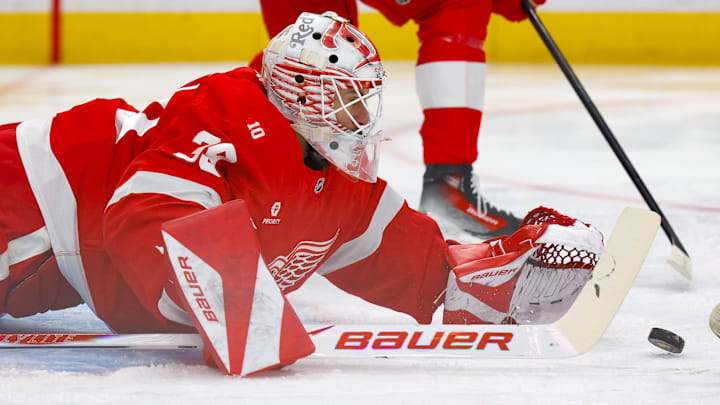
When the Detroit Red Wings lost to the Utah Mammoth on Wednesday, it was easy to point the finger at the goaltending. Cam Talbot hasn't been as sharp lately, and he allowed four more goals in that loss. Meanwhile, John Gibson's play has finally started pointing north. So the game was obviously on Talbot, right?
Not so fast. Following the game, head coach Todd McLellan noted otherwise. McLellan said, “I thought the difference tonight was obvious. It was the play around the nets, and I’m not talking about goaltending. I’m talking about clearing and batting pucks away, and making sure to get sticks on pucks in the slot area.”
That's an issue in front of the net, and it's not the first time McLellan has brought it up. In late November, following a loss to the Tampa Bay Lightning, their lack of a solid netfront presence doomed them. For fans, this is frustrating because the Red Wings look like a team capable of winning the Atlantic Division outright, but they can't seem to keep their act together consistently enough.
Detroit Red Wings' netfront presence is starting to haunt them
Maybe if that presence had been more consistent, then it's fair to wonder if John Gibson would have played so poorly earlier in the year. This isn't saying he wouldn't have put up subpar play, given how many times he allowed four-plus goals or saw his save percentage dip below 0.900. But if it's late December and this issue has been going on for a while, it's safe to say the Wings weren't giving Gibson as much help as they should have.
The Wings need to learn how to do a better job boxing out opponents, cleaning up chaos in front of the net, and making life difficult for opponents when they have the puck. What's more frustrating is that they have proven they can do this, with two shutout wins in a recent road trip when they allowed 16 goals in six games.
They still allowed too many looks, with opponents taking 190 shots on goal in that span, or 31.6 per game. That's not sustainable when you're trying to maintain a lead in an increasingly tight Atlantic Division.
There is good news for the Red Wings despite their lack of a netfront presence
The Red Wings have consistently shown they can bounce back from bad games and poor stretches. They went 5-7-2 in November, and for a second, it looked like they would be, at best, fringe playoff contenders.
Then they fixed their scoring issues, proved they could win consistently on the road, and even their depth scoring, which was nonexistent earlier in the year, picked up. If the Wings weren't finding ways to remedy their list of ongoing problems, they wouldn't be a top-three team in the Atlantic.
Fixing their poor performance in front of the net is the next issue on their to-do list. Still, they can't afford to figure out how they're going to play opponents well in front of the net and let another problem they solved, like depth scoring, haunt them again. If the Wings want to be an elite team, they must turn every weakness they have into a strength.
 Add us as a preferred source on Google