

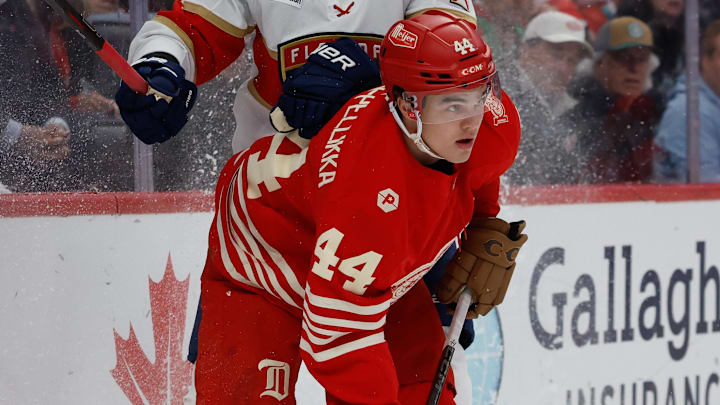
Most Detroit Red Wings fans hoped that they'd see more from the youth this season.
Of course, unexpected surprises like Emmitt Finnie were welcome additions to the roster. But, at this point in the rebuild, many hoped for a difference-maker like Moritz Seider or Lucas Raymond to manifest himself. There were times that rookie Axel Sandin-Pellikka looked like the real deal. There were also times, though, where he was the least valuable defenseman on the ice.
This isn't due to a lack of talent, though -- in fact, talent and pedigree has nothing to do with struggles.
The NHL's 82-game season is somewhat of an anomaly in the hockey world. In the AHL, the regular season is only 72 games long. The SHL, where Sandin-Pellikka played last year, is a light 52 games. The WHL, Finnie's home last season, had just 68 games. Transitioning to NHL ice is already hard enough. The rigor of the season takes a toll on your body. To do it across an 82-game slate is another thing entirely.
Maybe the rookies just got tired.
A human element to rookie struggles
Put yourself in the shoes of an NHL rookie -- specifically, put yourself in the shoes of a guy like Axel Sandin-Pellikka. You've just moved halfway around the world to play a game you've spent your entire life playing. In North America, the ice is much smaller. Players are faster, more physical and will burn you for even the simplest of mistakes. By your own merit, you manage to make the NHL roster. As the season toils on, your body takes on a toll it's never taken on before.
You're exhausted. Your mistakes continue to pile up. Before you know it, you're scratched several games. Then you're off to the AHL. This isn't to say that Sandin-Pellikka's mistakes on the ice carry no weight. This is about perspective. Younger players aren't battle-tested like the pros. More often than not, they struggle through dips in production or sophomore slumps like Marco Kasper's case.

Not every player is going to blow the doors off the stadium like Raymond and Seider -- at least, not right away, that is.
Strength, conditioning will solve Red Wings woes
The good news is that this is an extremely solvable problem. As these younger players continue to adjust to the NHL's rigorous schedule, they'll grow stronger. They/ll become more confident. This offseason is an opportunity to work on strength and conditioning. That way, later in the season, they'll have greater reserves of energy.
This isn't a problem isolated to just the Red Wings, either. There are, of course, exceptions to the rule (like Beckett Sennecke's performance with the Anaheim Ducks), but lulls in production are extremely common with younger NHLers.
In order to solve this problem, the younger Red Wings need to work on their strength this offseason. Building muscle and conditioning will give them a much greater chance of succeeding in the 2026-27 season.
 Add us as a preferred source on Google