

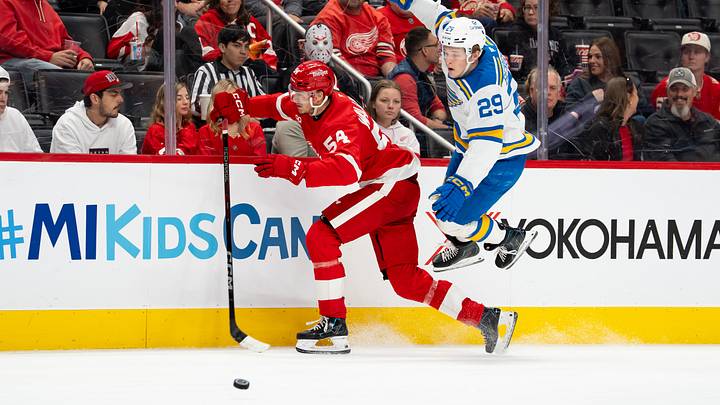
The Detroit Red Wings have searched high and low for a defensive pairing that could follow up Moritz Seider and whichever guy he’s paired with on any given shift. They’ve tried young guys, old guys and others that we really shouldn’t talk about ever again. Former general manager, Steve Yzerman, shouldered much of the blame in not finding the most suitable guys to play second pairing roles in Detroit.
It wasn’t for a lack of trying. However, the output of any second pairing defensive unit left much to be desired.
Before he departed, Yzerman left many presents: a fantastic signing in Viktor Arvidsson and the trade for Justin Faulk are both paying off in spades.
There may be an intriguing market for Justin Faulk growing, and the Red Wings are actually in a position of strength on the right side of their defense group.
For now, Faulk is creating a stable second pairing with youngster William Wallinder.
Detroit Red Wings might have found their second defensive pair
As of October 30, Hockey Alchemy on Twitter shared this fun tidbit:
The NHL's best defence pairs at 5v5 this season, by share of on-ice expected goals while together.
— Hockey Alchemy (@hockeyalchemy) October 30, 2026
Wallinder · Faulk (#LGRW) lead at 70.4% over 86 minutes.
True co-on-ice units rebuilt from shift stints — not deployment lines.#NHL pic.twitter.com/Rs4ZmsSKSM
Leading the league with an expected goals for (xGF%) of 70.4% with an impressive Corsi for percentage (CF%) of 62.8%, the pairing is putting up impressive figures.
Taking these numbers with a grain of salt is important, though. The Red Wings have rotated defensemen quicker and more often than Dylan Larkin quits on his team, which is an impressive feat in its own right.
Together, Faulk and Wallinder have shared the ice at five-on-five at just over 101 minutes (as of writing this on November 2), per Natural Stat Trick. Only Ben Chiarot and Moritz Seider have played more together on the backend.
In terms of performance, of the two pairings Faulk and Wallinder outshine Chiarot and Seider (as expected as their deployment isn’t nearly as challenging). However, it’s still impressive to see their 59.51 CF% and 63.75% xGF% (as opposed to 53.60 CF% and 56.01 xGF% of Seider and Chiarot’s pairing).
It’s typical that Seider, and in this case Chiarot, have the hardest deployment of 21 defense zone starts as opposed to 16 for the Wallinder and Faulk pairing. Emphasizing the sheltered minutes even further, Faulk and Wallinder have a 53.33% offensive zone faceoff percentage as opposed to 45.71% (meaning they get a head start in the offensive zone, whereas Seider and his current partner Chiarot are tasked to with breaking the puck out of their own zone, thus making the drive for offense harder).
In short, if a player starts in the offensive zone, it’s a lot easier and less work to create offense and have great numbers than if the pairing starts in the defensive (or even neutral zone).
Wallinder and Faulk finding immense success together
Even if they haven’t been together long and are more sheltered than Seider’s pairing, they are succeeding in their current role.
It will be interesting to see if Detroit Red Wings head coach Todd McLellan starts increasing the workload of Faulk and Wallinder given their remarkable success. Although it’s important to keep Wallinder’s confidence level high and not throw too much at him at once, it’s also imperative to lighten Seider’s load as much as possible, as soon as possible.
Wallinder provides a prototypical Swedish defense-style that Red Wings fans have been so lucky to see across their history. He's a smooth skater with a great two-way game. The only thing he needs to improve is his consistency in decision-making, positioning and output. That said, he's improved every game, which is a great thing to see as the Wings fans have desperately needed help without Simon Edvinsson or Albert Johansson in the lineup.
Faulk might not be the most consistent defenseman, but he has provided impressive offensive drive and serves as an interesting foil to Wallinder. In an ideal world, perhaps Wallinder would be paired with a more stay-at-home defenseman. Despite this, the balance between Faulk and Wallinder seems to be going well.
McLellan emphasized in Monday's pregame media availability that the duo has performed well. He likes what Wallinder brings to the table, especially as his confidence increases. On the other hand, McLelland has come to appreciate Faulk's on and off ice presence.
Faulk isn't shy. He provides on ice play that can be predictable and wild at times. To have an older presence on the bench, one who doesn't run away from problems, to help stabilize the bench and dressing room is important as well.
To put it delicately, the Red Wings are not at a point that fans can start singing Survivor's "Search is Over" just yet about their second pairing. Yet, they give us hope.
The Detroit Red Wings had an uphill climb before the season even began, so finding any way to balance the workload on defense will be key to any possible future success.
Hopefully, we get to see a bit more from both Wallinder and Faulk as the season goes along.
 Add us as a preferred source on Google