

As the calendar flips into the second week of March and the postseason comes into focus, the Detroit Red Wings find themselves in a spot that feels both promising and precarious.
They were real buyers at the NHL Trade Deadline, and the roster looks deeper on paper. But the stretch run has a way of exposing thin margins—and right now, Detroit has a few concerns that are hard to ignore.
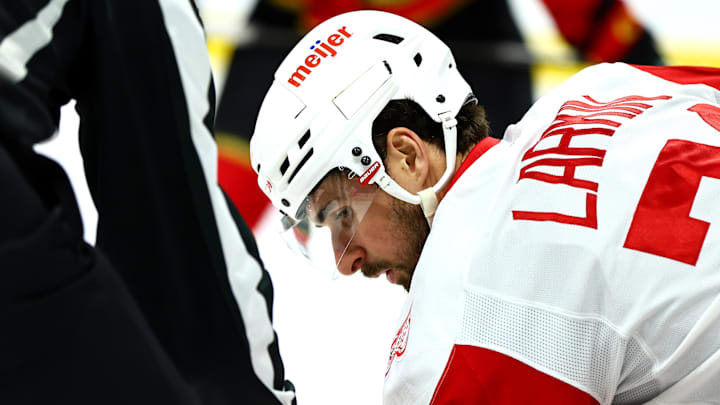
The biggest is health. Captain Dylan Larkin is considered day-to-day after an awkward fall in Detroit’s loss to Florida that appeared to impact his knee and/or groin. “Day-to-day” can be a flexible label around the league, and Detroit has historically been tight-lipped with injury timetables.
In the past, day-to-day has often turned into week-to-week; let's hope that isn't the case with Larkin. For a team that didn’t manage to add an impactful center at the deadline, the Red Wings can ill-afford to be without Larkin for any meaningful length of time.
Houston, the Detroit Red Wings have a problem
Then there’s the standings reality. Detroit is 3-5-2 over its last 10 games and has slipped into a wild-card position. Heading into Sunday’s tilt with the New Jersey Devils, the Red Wings sit at 77 points—one behind the Montreal Canadiens for third in the Atlantic Division.
Montreal, meanwhile, is 6-1-3 in its last ten, gaining ground at the exact moment Detroit is wobbling. The Red Wings do hold a two-point edge on Boston, with a game in hand, but the race is getting crowded in a hurry. The Columbus Blue Jackets (73 points) and Ottawa Senators (71 points) are both 7-1-2 over their past ten games, and both are playing like teams that have decided the door is still open.
Here’s the most concerning part: among every team currently in a playoff position—plus the two just outside looking in—the Red Wings are the only one with a negative goal differential. Detroit sits at minus-4. Compare that to Montreal at plus-13, Boston at plus-13, Ottawa at plus-14, and Columbus at plus-2. Elsewhere in the conference race, Buffalo is sitting at plus-31, and Tampa Bay, the one-seed, is the leader in the clubhouse with a blistering plus-52.
Goal differential isn’t everything, but it often tells the truth over time. It speaks to how frequently you’re chasing games, how tight your wins really are, and how forgiving your margins become when the schedule tightens.
With goaltender John Gibson playing as well as he has, and the addition of defenseman Justin Faulk, Detroit has reasons to believe the number can slightly improve. Still, it also highlights why the Red Wings needed to add a bona fide goal scorer at the deadline—and no, David Perron doesn’t fit that criteria.
If Larkin’s absence is brief and the new additions stabilize the back end, Detroit can absolutely hold its place. But if the captain misses significant time and the goal differential stays underwater, the Red Wings may be asking their playoff hopes to survive a month where almost everyone around them is surging.
 Add us as a preferred source on Google