

The Detroit Red Wings did make a pair of notable additions ahead of Friday’s deadline, acquiring veteran winger David Perron for a conditional fourth-round pick while also landing top-four defenseman Justin Faulk from the St. Louis Blues.
Both moves fit the profile of players Yzerman has historically targeted: experienced veterans with defined roles and manageable contracts. Faulk, in particular, feels like a natural fit.
The 33-year-old right-shot defender is averaging more than 22 minutes a night and has contributed offensively with 11 goals and 21 assists this season. His blend of reliability and puck-moving ability should slot comfortably into Detroit’s top four on the second pairing behind Moritz Seider.
This addition didn’t come out of nowhere, either. Faulk had been on my personal wishlist of potential trade targets dating back to December. At 33 years of age and under contract for another season with a $6.5 million cap hit, he checks many of the boxes Yzerman tends to prioritize: term remaining, a clearly defined role, and a skill set that complements the roster.
David Perron brings veteran Depth to Red Wings
The Perron acquisition may not generate the same headlines, but it could quietly become an important depth move. At 37, Perron is very much a bottom-six forward at this stage of his career. However, his skill set still offers value—particularly along the boards and in offensive-zone puck battles.
Don’t be surprised if head coach Todd McLellan experiments with Perron alongside Dylan Larkin and Lucas Raymond from time to time. Even in his later years, Perron retains the creativity and finishing ability to complement Detroit’s two most dynamic forwards. Speed and skating have never been Perron’s calling card—he was never winning many skating contests even in his prime—but pairing him with two elite skaters can help mask that limitation.
More realistically, Perron likely settles in as a fourth-line winger and power-play specialist once he returns from the sports hernia that has sidelined him since January 20. At the very least, he adds some much-needed secondary scoring and a dose of championship experience.
Still, while Detroit addressed a few needs, several intriguing targets ultimately slipped through the organization’s fingers. And as the club awaits an update on Larkin’s status following an awkward fall Friday night against the Florida Panthers, the absence of additional center depth could loom large in the weeks ahead.
Players the Red Wings wanted to target but got away
Vincent Trocheck
The first—and perhaps most obvious—missed opportunity was Vincent Trocheck of the New York Rangers.
With the Rangers reportedly embracing a full rebuild, Trocheck seemed like a logical target for Detroit. The Red Wings have been searching for a legitimate one-two punch down the middle since franchise icons Pavel Datsyuk and Henrik Zetterberg hung up their skates. In other words, Detroit still needs a Robin to Larkin’s Batman. Trocheck would have fit that role perfectly.
The 32-year-old center has recorded 12 goals and 39 points this season and remains one of the league’s most consistent two-way pivots. He has scored 20 or more goals in seven seasons during his career, including each of the last four consecutive seasons. More importantly, he embodies the type of player Yzerman covets: dependable in all three zones and capable of logging heavy minutes in every situation.
Trocheck averages around 20 minutes per night and dominates in the faceoff circle. His 57.2 percent success rate this season follows marks of 59.3 percent and 58.7 percent over the previous two campaigns.
As a right-handed shot, he also would have provided McLellan with valuable flexibility late in games. Deploying both Trocheck and Larkin in defensive situations would allow Detroit to take critical draws on their strong sides.
Trocheck is currently in year four of a seven-year contract carrying a very reasonable $5.625 million average annual value. Simply put, he checks every box, which means the Rangers’ asking price must have been astronomical for Detroit not to complete a deal.
Robert Thomas
If Trocheck represented the ideal veteran addition, Robert Thomas, and no, not the lead singer from Matchbox Twenty, would have been the franchise-altering swing.
The 26-year-old center is firmly in the prime of his career and already producing at a near-elite level. Despite battling a shoulder injury this season, Thomas has recorded 15 goals and 39 points in just 45 games. That, on the heels of back-to-back seasons of 81 and 86 points.
Thomas possesses the same two-way reliability as Trocheck but with significantly more offensive upside. Acquiring him would have immediately transformed Detroit’s forward group. The problem, of course, was the price.
According to Chris Johnston of TSN, the Blues were seeking a massive return that would have started with a first-round pick, along with NHL-ready players and prospects. Thomas is also under contract long-term, currently in year three of an eight-year deal with an $8.125 million cap hit.
For a player of his caliber and age, that contract is hardly unreasonable. In fact, landing a player of Thomas’ ability through the draft—and then signing him to a manageable long-term deal—is far from guaranteed. Still, the acquisition cost was likely just too steep for Yzerman’s liking.
Among the players discussed here, Thomas probably would have had the greatest impact on Detroit’s lineup.
Defensive targets that didn’t materialize
Detroit was also connected to a pair of veteran defensemen before ultimately landing Faulk:
Rasmus Ristolainen
One name frequently mentioned was Rasmus Ristolainen of the Philadelphia Flyers. At 6-foot-4 and right-handed, the 31-year-old would have brought a physical element to Detroit’s blue line while filling a similar role to the one Faulk now occupies.
Ristolainen no longer provides the offensive production he once did earlier in his career, but his size and defensive presence could have been valuable in playoff-style hockey.
Ultimately, Philadelphia held onto him, suggesting the Flyers either weren’t actively looking to move him or didn’t receive an offer compelling enough to justify a deal. Had Detroit missed out on Faulk, Ristolainen would have been a solid fallback option. Personally, though, Faulk remains the better fit.
MacKenzie Weegar
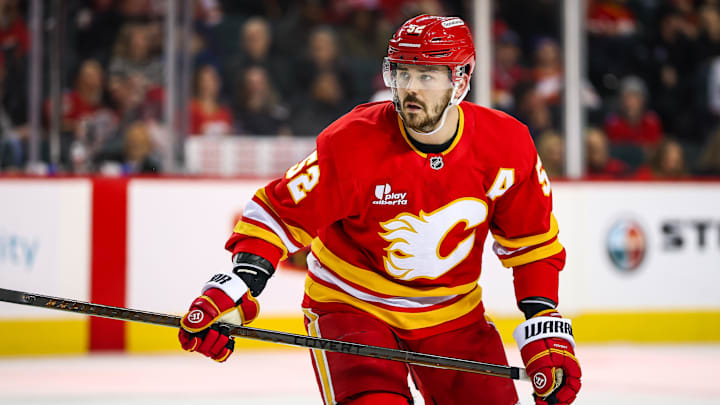
The other defender linked to Detroit was MacKenzie Weegar of the Calgary Flames. Weegar arguably offered the highest offensive upside among the defensemen Detroit explored.
Despite posting three goals and 21 points this season while playing on a struggling Flames team, Weegar recorded 20 goals and 52 points just two seasons ago and followed that with a 47-point campaign last year.
In Detroit, he would have slotted perfectly onto the second pairing while also providing a polished right-handed option on the top power play—potentially allowing Seider to ease his heavy workload.
Instead, Calgary dealt Weegar to the Utah Mammoth in a package that included former Red Wing Olli Maatta, prospect Jonathan Castagna, and three second-round selections. If you know Yzerman, that type of price tag simply feels too rich.
Weegar, like Faulk, also carries a reasonable contract—currently in year three of an eight-year deal with a $6.25 million cap hit.
 Add us as a preferred source on Google