

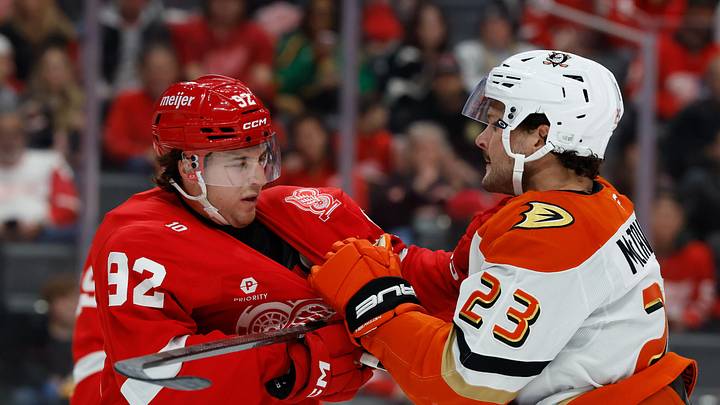
The term "sophomore slump" is thrown around a lot in professional sports. As the name suggests, the sophmore slump occurs when a player, after a promising rookie year, takes a step back his second season. It's an extremely common phenomenon across sports; typically, it occurs when other teams start getting footage on the rookie to figure out how to shut them down.
The sophomore season is a learning experience for any would-be professional athlete. The truly great athletes typically find ways to improve their game and kick things into high gear in their third seasons. Lucas Raymond, for example, struggled his second season only to break out his junior year. But no other player on the Red Wings struggled with their sophomore season quite like Marco Kasper has.
In 81 games with the Red Wings, Kasper managed just 19 points -- less than a quarter point-per-game. A myriad of factors played into this: inconsistent line mates, poor finishing and a lack of quality minutes all played a part in the slump.
Still, it's fair to expect more from Kasper than what he brought to the table.
Why Kasper disappointed this season
As mentioned earlier, Kasper never really had consistent line mates this season. He played with everyone from Dylan Larkin to J.T. Compher, and, by the end of the season, saw the majority of his minutes alongside David Perron and Compher or James van Riemsdyk and Dominik Shine. Neither pairing is particularly conducive to high offensive marks.
Having said that, he had plenty of opportunity to establish himself with other lines throughout the season. He started the year with Alex DeBrincat and Patrick Kane and even had a few shifts on the top line with Dylan Larkin and Lucas Raymond. As the season progressed, Kasper continued to struggle to finish. Due to this ice time took a dip, going from around 14:53 a night to 13:44 as a result.
That said, there's little to worry about from a long-term standpoint with Kasper.
Kasper poised for bounce back season with Red Wings
Per analytics guru JFresh, Kasper had among the lowest finishing percentages in the NHL:
No need to hit the panic button on Kasper. A bad shooting season and crummy on-ice shooting as well sunk his point totals, but under the hood he looks fine. I expect him to be back on track next season. https://t.co/dPWRTi26Zg pic.twitter.com/oCN2ggRBva
May 15, 2026The Austrian forward's underlying metrics suggest that he's poised for a bounce back season next year. His offensive and defensive numbers are among the top quarter at the NHL level. All he needs is to refine his game and work on his finishing. Fortunately, the front office appears to be on the same page; McLellan even went out of his way to talk about how much they believe in him.
It's entirely possible that Kasper has a breakout season next year. Should he properly develop, the Red Wings will have another weapon in their repertoire to throw at their opponents. When looking at this season, however, there's no other word that can describe it other than disappointment. This was supposed to be a big year for Kasper -- a chance to show he's a 2C in the making. Instead, a season later, the Red Wings are now on the hunt for a long-term replacement.
Final Grade: D+
 Add us as a preferred source on Google