

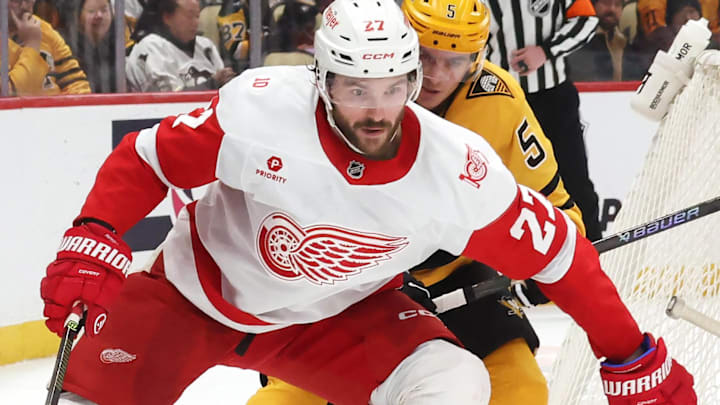
With the Red Wings coming off a spectacular December and sitting near the top of the Atlantic Division, several players are being praised for their contributions.
The usual suspects like Lucas Raymond, Alex DeBrincat, and Moritz Seider may be leading the charge, but the improvements by John Gibson and Andrew Copp have been equally covered and pointed to as reasons for Detroit’s success.
However, another Red Wing recovered from a horrendous start to the season and his performance has flown under the radar.
That player is Michael Rasmussen
After the first few weeks of the year, Rasmussen’s days in Detroit looked to be numbered. He plummeted down the lineup and was even a healthy scratch. He was invisible most nights, lacking energy and posting just five points by American Thanksgiving.
It seemed inevitable that Ras would follow Jonatan Berggren out of Detroit, especially with the continued development of forward prospects like Emmitt Finnie and Nate Danielson. Then, out of nowhere, like with Gibson and Copp’s revitalizations, Rasmussen has emerged as a key cog in the Red Wings’ recent winning.
Since Nov. 28th, Rasmussen has nearly doubled his offensive production from pre-Thanksgiving with nine points in 19 games. This includes his current stretch of five points over his last seven contests. He even scored the Wings’ first short-handed goal in 78 games on Monday night against the Ottawa Senators.
It is not just the scoring that has improved, however. Rasmussen’s energy and physicality have returned to his game.
The former first-round pick is finally using his 6’6’’ frame to his advantage, something Detroit fans have begged for since 2018. He is seventh on the team (and fourth amongst forwards) with 40 hits, despite having less ice-time than guys like Seider or Ben Chiarot at the top of the list.
Ras has been stronger defensively and on the forecheck, while also not getting bodied for pucks nearly as much as he did to start the season. He is also a staple of the Detroit penalty kill, helping it improve from 32nd last year (70.11 percent) to 14th this year (80.7 percent).
Copp, Mason Appleton, and James van Riemsdyk may be getting most of the credit for the turnaround of Detroit’s depth forwards and deservedly so. Still, Rasmussen has been just as good as those forwards and Wings fans should be aware that he is playing more confidently than ever before.
What is the reason for Rasmussen’s growth?
Nothing is for certain, but head coach Todd McLellan likely has a lot to do with Rasmussen’s improvement.
Since taking over in December 2024, McLellan has been vocal of the Red Wings’ lack of competitiveness and energy at times. He has stated that Detroit has too many passengers who have been on the team for too long and are still not fed up with all the losing.
McLellan also alluded to players needing to shape up or be shipped out in order to improve the culture around the team.
It does not take a rocket scientist to gather that McLellan’s comments were in some part targeted towards Rasmussen, further evidenced by his benching earlier in the year.
Maybe McLellan and Rasmussen had a conversation, or his healthy scratching was enough of a wakeup call, but regardless a fire was lit under Ras and his recent performance demonstrates this.
It is also worth noting that, whereas Berggren and the Wings mutually decided to part ways, Rasmussen chose to start working harder and playing better. This shows that both Ras and the team want him to stay in Detroit.
Rasmussen might return to his previous form, but this turnaround feels sustainable and the trust he is earning from the coaching staff is promising. He also is somehow only 26-years old, meaning he could easily be a part of Detroit’s future if he keeps this up.
 Add us as a preferred source on Google