

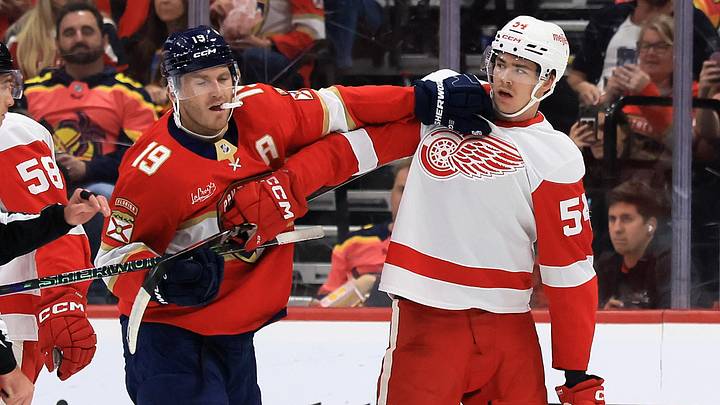
The Detroit Red Wings are 8-10-3, good for seventh in the Atlantic Division, just ahead of the Toronto Maple Leafs. Things could certainly be worse, but they could, obviously, be better. The Red Wings, despite the adversity of the early season, have shown they're not going to back down like teams in the past.
That said, they do look like they're missing a few pieces -- namely a top center and their second-best defenseman.
Still, despite what the record may show, the team has made some major improvements across the ice. Even-strength scoring is up. Young players are coming into their own. The roster seems to be figuring out more consistency as the season goes on.
What stands out the most, though, is the team's improved defense.
How the defense is finding success
The Red Wings are currently playing a 1-3-1 style. This places a lone forward at the forecheck, two other forwards and a defenseman in the middle and the final defenseman in the back. Some refer to this style as the "trap", as it's often used by defensive teams to stifle oppositional scoring opportunities. While not particularly exciting on the offensive front, from the defensive side of things, it's been working quite well.
One big reason for this is the emergence of William Wallinder and Justin Faulk as an analytically brilliant defensive pairing. While still a small sample size, Wallinder and Faulk consistently rank among the top-five in terms of expected goals against. That means opposing teams score less - and possess the puck less - when Wallinder and Faulk are on the ice together.
Could it be because Faulk is overhated? Or is it because Wallinder is underrated? Perhaps it's a bit of both. The emergence of Anton Johansson as a stalwart bottom pairing defenseman has helped to keep the roster engaged, as well. Johansson is just as capable of throwing hits as he is making huge passing plays. Despite limited time on ice, Johansson is fourth in scoring among all Red Wings defensemen. He's doing it all behind two players on the power play (Moritz Seider and Justin Faulk) and Wallinder, who plays more per night than Johansson.
But the real star of the show is what makes this defense so special.
Moritz Seider is just too good
We're a quarter of the way through the season and defenseman Moritz Seider has found himself with a rotating cast of characters as his defensive partner. First, it was Albert Johansson, who performed relatively well in an increased role. Then, when Johansson went down with an injury, Ben Chiarot took his place. If Johansson played well, Chiarot on the top pairing was a disaster. His analytic performance consistently ranks among the worst defensemen in the league.
Yet, despite this, Seider somehow found a way to carry him into relevance.
It doesn't matter how bad Chiarot's numbers are; when paired with Seider, they still rank among the top in the league in expected goals against. Seider, now, is paired with Wallinder until Albert Johansson (or Simon Edvinsson) return to the ice.
While there are still several improvements the defense needs to make (like not pinching or cheating in the defensive zone), the improvements when compared to last season are staggering. Yes, they clearly miss the help of Simon Edvinsson, but it's clear that the rise of Wallinder and Anton Johansson has played a huge role in getting this defense right.
Final Grade: B
 Add us as a preferred source on Google