

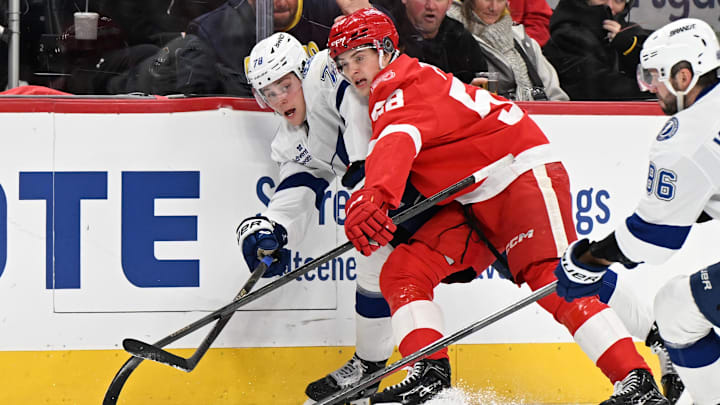
The return to play begins with a crucial divisional matchup against Ottawa — one of many “must-win” games in Detroit’s chase for its first playoff berth in a decade. Amid that focus on the big picture, it’s worth spotlighting one of the season’s most intriguing stories: Emmitt Finnie, the seventh-round surprise who’s become impossible to ignore.
Finnie’s journey to the NHL is one of those feel-good stories that never get old. Making the roster as a 20-year-old seventh-round pick isn’t just rare — it’s almost unheard of. Yet, for a franchise that’s long prided itself on finding late-round gems, it feels fitting. The Red Wings’ history is rich with underdog success stories — from Pavel Datsyuk to Henrik Zetterberg — and while no one is placing Finnie in that company just yet, his emergence carries that same spirit.
What makes Finnie’s first season impressive isn’t just that he’s stuck around. It’s how he’s adapted. Through 58 games, Finnie has produced nine goals and 12 assists for 21 points, putting him on pace for roughly 30 by season’s end — solid output for a player who, before this year, had only 13 games of professional experience.
He began the season on the top line with Dylan Larkin and Lucas Raymond but was eventually moved into a bottom-six role following a scoring slump. Since then, he’s become a reliable, hard-nosed depth option — the kind of player every contender needs when games tighten up.
Finnie brings a physical edge and disciplined play to Wings
While his production has cooled off recently, Finnie’s impact hasn’t. He’s leaned into the physical side of his game, ranking fourth on the team with 86 hits — trailing only Marco Kasper, Ben Chiarot, and Moritz Seider. What makes that number stand out is his efficiency: despite the contact, Finnie has taken just six penalty minutes all season.
That balance of intensity and control is rare for a rookie. Finnie plays hard without crossing the line, showing the type of maturity that coaches trust in key moments. It’s the kind of attention to detail that defines players who thrive in the postseason, when the hits get heavier and space disappears.
Finnie’s rookie campaign has had its growing pains, but context matters. His expected-goals rate sits at 13.7 according to Money Puck — nearly five higher than his actual goal total — meaning he’s been generating chances even when the puck isn’t going in.
Beyond the numbers, his shift-to-shift consistency and situational awareness continue to impress. Like his scouting reports hinted, Finnie’s game is built on anticipation. He reads plays early, finds soft ice, and disrupts opposing breakouts with quick stick pressure. He may not have explosive hands or elite agility yet, but he compensates with strong reads, smart routes, and constant motion.
That high motor was evident during his WHL days, where his mix of effort and positioning stood out even when ice time didn’t. This shows a history of being noticeable and a positive force for his team despite limited ice time and production, much like he is facing now in Detroit's bottom six.
Making such an impact in a limited role as Detroit enters the playoff stretch and hopefully the playoffs themselves is great for versility as the Wings look to deepen their roster at the Trade Deadline.
The Darren Helm comparison and playoff potential

If the Red Wings do clinch a playoff spot, Finnie’s adaptability could make him the kind of depth piece fans rally around. His straight-line speed and tenacious forechecking resemble the type of hockey that defined Darren Helm during Detroit’s deep postseason runs. Helm became a fan favorite not for flash or highlight-reel goals, but because of how he impact when it mattered most — with speed, tenaciousness, effort, and purpose in limited minutes
Finnie brings a similar energy. His skating, while not technically perfect, is powerful enough to close gaps, win races, and sustain forecheck pressure. His 51 percent Corsi For rating — meaning Detroit controls a slight majority of shot attempts when he’s on the ice — reflects how often he helps tilt possession in the team’s favor. In simple terms, when Finnie is out there, the puck is usually heading the right direction.
It’s easy to imagine him becoming that player every playoff team leans on — the one who kills momentum for opponents with relentless pressure and responsible, physical play. As one colleague recently highlighted in their look at Detroit’s potential breakout stars, Finnie's ability to adapt quickly to new roles is invaluable during the grind of a season. It also opens the door for offensive growth down the road.
While Finnie’s early-season top line position drew the headlines, his versatility and durability might be even more meaningful. His ability to adapt from a top-line scoring role to a depth grinder — and still find ways to help the team — says everything about his hockey sense and work ethic. It’s the same growth mindset that has kept him noticeable on track all year.
Every shift now feels like another lesson — when to finish a hit, when to stay above the puck, when to make the simple play. Those adjustments don’t always show up on the scoresheet, but they build trust, and that trust is what keeps young players in the lineup.
The bigger picture for the Red Wings and Finnie
Detroit’s push for the postseason is a team story, but within it, individual arcs like Finnie’s give it texture. He’s not lighting up the scoreboard, but he’s providing the kind of glue every playoff roster needs.
He’s learning to play fast without forcing plays, to be physical without losing discipline, and to bring value even on nights when the points don’t come. That kind of self-awareness and two-way reliability are the same traits that once turned depth forwards into playoff heroes in Detroit’s glory years.
Finnie’s ceiling is still taking shape, but his foundation — awareness, pace, effort, and adaptability — is already there. If the Red Wings reach the postseason, don’t be surprised if Emmitt Finnie becomes the name fans can’t stop cheering for.
 Add us as a preferred source on Google