

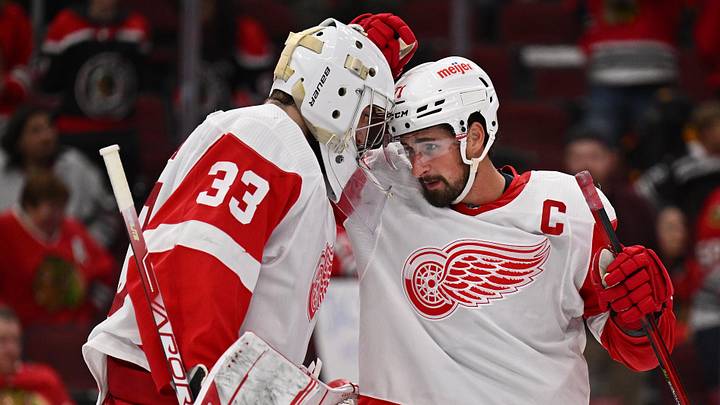
The Detroit Red Wings enter the offseason with a clear need behind John Gibson. Assuming the organization does not bring back soon-to-be 39-year-old Cam Talbot, there will be an opening for the backup role.
Talbot appeared in 34 games during the 2025-26 season, posting a 3.19 goals-against average, a .883 save percentage, and a 12-9-6 record. Those numbers simply are not where Detroit needs them to be if the team plans to seriously push for a playoff spot next season. Ideally, the Red Wings would want stronger production from whoever fills the role behind Gibson.
Cam Talbot… time to wrap it up buddy https://t.co/StwGfKijDP
— Zay 🍁🏒 (@BestOfZay) May 21, 2026
Finding reliable goaltending around the league is not easy. In 2025-26, only 23 goalies who played at least 25 games posted a save percentage above .900, while only 21 finished with a goals-against average under 2.70. Similar trends have carried over the last few seasons, showing just how difficult consistency in net can be. Detroit needs a backup who can provide that kind of stability behind John Gibson.
Now that the Grand Rapids Griffins' season has come to an end, attention shifts toward the internal options waiting in the pipeline. Detroit may already have its answer without needing to spend assets elsewhere.
Thank you all for being there for us all season long 👊‼️ pic.twitter.com/pL1hw2qhdd
— y-Grand Rapids Griffins (@griffinshockey) May 22, 2026
Option 1: Michal Postava
An undrafted free agent out of the Czechia league, Michal Postava quickly turned heads in his first North American season. Not only did he adapt well to the AHL game, but he eventually earned the starting role for Grand Rapids during the playoffs.
Postava finished the postseason with a 2.09 goals-against average, a .912 save percentage, one shutout, and a 4-4-0 record across eight games. Considering the Griffins struggled at times on both special teams and with offensive support, those numbers become even more impressive.
His playoff performance alone should create intense competition this summer. The question becomes whether Detroit wants to accelerate his development immediately or allow him to continue refining his game with heavier playing time in Grand Rapids and challenge Trey Augustine.
UNREAL SAVE BY MICHAL POSTAVA!!!#GoGRG #AHL #LGRW pic.twitter.com/6WRdW5YJYn
— Hockeytown West Podcast (@HockeytownWpod) May 15, 2026
Option 2: Sebastian Cossa
Drafted in the first round of the 2021 NHL Draft, Cossa has now built a significant amount of experience at the AHL level. Across four seasons and 123 career games, Cossa ranks 83rd all-time in AHL games played among players under 24 years old. His overall body of work has been impressive, posting a 2.46 goals-against average, .911 save percentage, 70 wins, 33 losses, 19 overtime losses, and eight shutouts.
While he did not receive playoff action this season, it is difficult to overlook the consistency he has shown over an extended period. The biggest argument for Cossa over Postava is sample size and development path. Postava had an excellent first season and an impressive playoff run, but Cossa has spent years adjusting to the North American game while carrying a larger workload.
The Red Wings also invested a first-round pick in him with the expectation that he could eventually become an NHL goaltender. Giving him 25-30 games behind Gibson next season could be a logical next step rather than continuing to delay his progression.
The BIG FELLA held it down for the WHOLE MONTH ⭐️👊 #GoGRG
— y-Grand Rapids Griffins (@griffinshockey) December 2, 2025
DETAILS | 🔗 https://t.co/Y1KdGmRYJn pic.twitter.com/XP6chyOCoT
Option 3: Trade or free agency
Neither free agency nor the trade market feels like the ideal path when Detroit already has two NHL-ready options in Cossa and Postava. However, there is still an argument to be made for experience.
The market itself is less than inspiring. There are only 15 unrestricted free-agent goalies available this summer, and none of them posted a save percentage over .900 while playing at least 25 games. Trading for another goalie could cost assets that Detroit may be better off keeping.
Who are you most comfortable with being the backup behind Gibson next season? 🐙#LGRW #RedWings
— Hockeytown Rundown (@HockeytownRD) May 14, 2026
Final decision
If I had to choose, I would lean toward Sebastian Cossa. While Postava earned the playoff nod and certainly made his case, Cossa's larger body of work gives him the edge. He has been developing in the system longer, has handled a heavier workload, and has shown consistency over multiple seasons.
For Detroit, the answer is already within the organization, and Cossa is finally ready for his opportunity.
 Add us as a preferred source on Google