

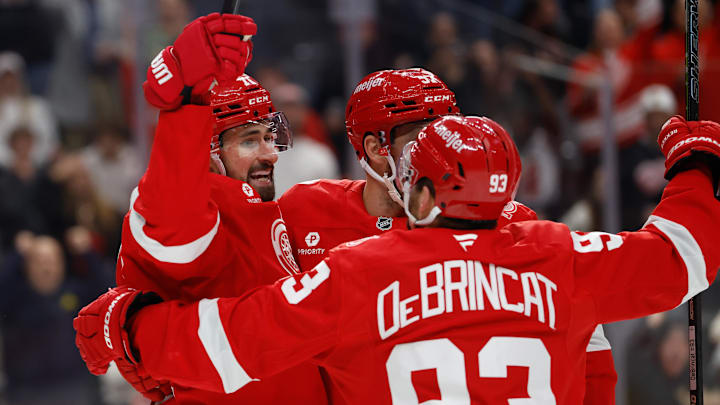
What more can be said about the 2025-26 Detroit Red Wings that hasn't already been said? The team yet again failed to meet the moment. They were far from effective when it mattered the most and, for the fourth March in a row, they fell apart. This offseason, something big has to change. If it doesn't, the team is destined to repeat the same mistakes it's made again and again over the last four years.
But how drastic of a change does that have to be? Some think one of the members of the core (i.e. Dylan Larkin, Moritz Seider, Alex DeBrincat and Lucas Raymond) needs to move. They've been frequently compared to the Toronto Maple Leafs of the past in that they've failed to meet the moment and come together as a squad.
The thing is, the core isn't the issue with the Red Wings. In fact, there's a slim to none chance that the core will change at any level whatsoever.
Why the Red Wings will stay the course
If you look at this roster and think one of Seider, Larkin, Raymond or DeBrincat is the problem, you haven't been paying attention. These four players are far and beyond the best on the roster. Where the team falls apart, however, comes from their depth. The bottom-six is nothing short of abysmal. When the going gets tough, the depth just simply doesn't get going.
That's the difference between the Red Wings and actual playoff teams. When star players struggle to produce, third liners and depth defensemen step their games up to shoulder some of the burden. When was the last time a depth forward stood up for the team? James van Riemsdyk showed shades of what the depth should look like but he became more inconsistent as the season went on. To add insult to injury, he's 36 -- one of the oldest players on the roster.
Why do the Red Wings expect one of the oldest players to be a top contributor when key depth additions like J.T. Compher and Michael Rasmussen should be stepping it up a notch? There's a clear disconnect between how the depth and the core operates. Until it's addressed, the Red Wings will remain on the margins of the playoffs.
The Red Wings should add to the core, not remove from it
Sure, trading someone like Raymond may net a high return. But when will that return come into play? Three years from now? Is it reasonable to expect players like DeBrincat and Larkin to wait an additional three years for extra talent to come into play?
It isn't a lack of star power that isn't driving Detroit ahead. After all, they have a top defender in the league and two point-per-game forwards as well as a high end two-way center. If anything, the Red Wings should be adding to this core, not subtracting.
The Red Wings targeted players like Robert Thomas and Vincent Trocheck during the last trade deadline. A player of similar caliber could be a huge difference-maker in Detroit. Robert Thomas, for example, would take the pressure off Dylan Larkin and allow him to better contribute without having to cover for two separate lines. It would give Andrew Copp a chance to play to his strengths on the third line. To top it all off, playing Thomas with players like Alex DeBrincat and Patrick Kane would surely bolster the trio's scoring totals.
Barring a massive overpay from another team, the Red Wings will not remove from their core.
 Add us as a preferred source on Google