

As of right now, Steve Yzerman's request in the Dylan Larkin trade fiasco is that the Detroit Red Wings receive NHL-ready players in return.
While, on paper, this is a smart idea, it's important to understand the context of the Atlantic Division as it stands.
The three top playoff teams last season - the Montreal Canadiens, Buffalo Sabres and Tampa Bay Lightning - all improved their roster to some degree or another. The Florida Panthers, who just won back-to-back Stanley Cups, are well-rested and upgraded with Brady Tkachuk in the lineup. Even the Boston Bruins and Ottawa Senators made changes to their roster, with the former adding JJ Peterka and the latter acquiring William Eklund.
The Red Wings, for comparison's sake, added Viktor Arvidsson and Keegan Kolesar.
As marginal as those upgrades might seem, they're actually a massive improvement on last season's free agency class. Yet, despite all this, nothing they did made them a legitimate needle-mover against teams like the Habs or the Lightning. Even the Senators, who lost Brady Tkachuk, made a push to improve.
With all that in mind, it might be best for the Red Wings to bottom out and accept their fate in the basement of the Atlantic.
Why bottoming out will be good for the Red Wings
Unfortunately for the Red Wings, they're in no place to compete in a stacked division. Had they been in the Pacific division, we'd be having a different conversation about the Red Wings' readiness for the playoffs. Instead, we're forced to contend with the reality that the Red Wings will almost certainly miss the playoffs for the 11th straight season.
This will involve quite a few uncomfortable conversations, the first being the fate of Alex DeBrincat. If the 40 goal-scorer sees himself as part of the future, he'll have an opportunity to sign a longer-term deal. If he wants to join a playoff team, though, Yzerman will need to explore what a return would look like.
DeBrincat isn't the only player up for a deal, though. Recent acquisition Justin Faulk is an unrestricted free agent at the end of next season. Players like Andrew Copp and Mason Appleton may offer tantalizing depth options for contenders -- and the Red Wings can even retain salary in the process.
This time around, though, the Red Wings shouldn't aim for draft picks. They should be approaching younger, near-NHL-ready talent. There's no telling what teams like, say, the Utah Mammoth would do to acquire a player like DeBrincat. Defensive depth, especially for a player like Faulk, can net a heavy return (as Red Wings fans are now aware).
If the team is truly dedicated to bottoming out, they're going to have to contend with this uncomfortable reality.
Youth movement would make major impact in future
That said, they've still got a strong young core of players like Moritz Seider, Lucas Raymond and Simon Edvinsson, with younger players like Axel Sandin-Pellikka and Michael Brandsegg-Nygard ready to take the next step.
This season should be an opportunity for the kids to fully take over on the lineup. Last season saw an early emergence of that, with Emmitt Finnie, Brandsegg-Nygard and Sandin-Pellikka all making the opening lineup. This time around, we should see multiple players force their way onto the lineup. They'll make mistakes, to be certain, but, until they understand the rigor of an NHL season, there's no telling what kind of player they'll become.
Top talent available in next draft
If the team does bottom out and keeps their draft pick, there's a (small) chance they can win the draft lottery and select Landon DuPont, a University of Michigan defenseman with elite potential. DuPont isn't the only player available, though. High-end centers like Alexis Joseph of the QMJHL and Milan Sunderstrom give the Red Wings a potential long-term option at center they can rely on.
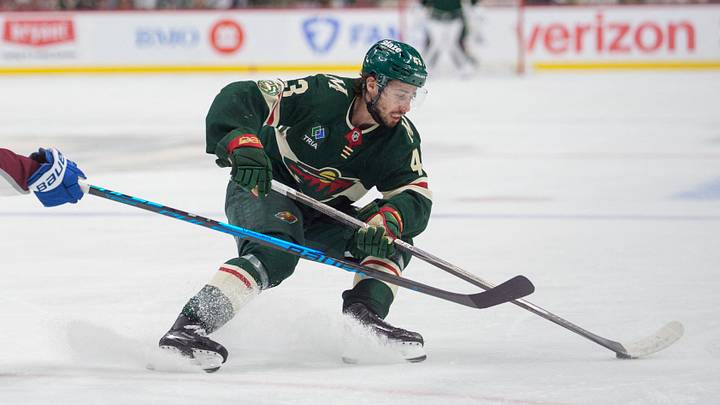
But - as the article's image may suggest - bottoming out doesn't just give the Red Wings a chance to draft high.
Next season's free agency class positively loaded
Take a look at next season's free agency class. What do you notice? Yes, there are a lot of upcoming free agents that are a little older, like Nikita Kucherov, Drew Doughty and Tyler Seguin, but one name in particular should stand out from the crowd: Quinn Hughes.
Minnesota Wild general manager Bill Guerin is under immense pressure to keep his American defenseman happy in order to extend him. If he's unable to get a deal done, Hughes will most likely walk. One of the teams he considered joining was - you guessed it - the Detroit Red Wings. If he doesn't make his way to the New Jersey Devils to reunite with his brothers, his hometown team is likely at the top of his list.
Should Hughes decide to stay with the Wild or join another team, the Red Wings can easily pivot to one of the numerous candidates available. Centers like Drake Batherson provide a measurable upgrade in the middle, while forwards like Kucherov and Mark Stone bring high-end, Cup-winning, veteran talent.
Oh, and that doesn't even scratch the surface with offer sheet candidates.
If the Red Wings manage to offer sheet one of Macklin Celebrini or Will Smith, they immediately gain young, top-line talent at the cost of a few draft picks.
It's tough to recognize, but, sooner or later, the Red Wings will need to decide on the direction the francise is going.
 Add us as a preferred source on Google