

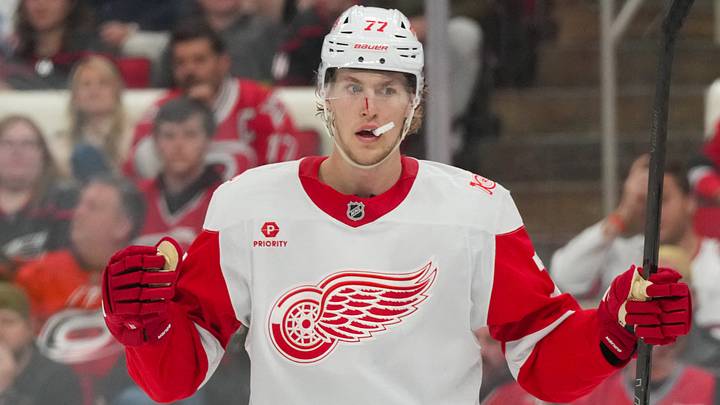
The Detroit Red Wings have an important decision to make with Simon Edvinsson, whose next contract could reportedly range from $9 million to $12 million annually.
The young defenseman has tremendous potential, particularly in his own zone, but Detroit has legitimate reasons to hesitate before committing that kind of money.
The Seider connection raises questions
Last season, Edvinsson posted a 52.63% expected goals percentage (xGF%) alongside Seider. Without him, that number plummeted to 11.86%. Seider also struggled without Edvinsson, recording a 22.62% xGF% in those situations.
While deployment and sample size can influence these numbers, the difference raises an important question: How much of Edvinsson's success comes from his own development, and how much comes from playing alongside an established No. 1 defenseman?
Detroit needs confidence that Edvinsson can consistently drive results independently before committing $9 million or more annually.
“It's not just an investment in Edvinsson on your blue line. It's also an investment in Moritz Seider.” 👀🏒 @JeffMarek and @wyshynski discuss Simon Edvinsson's next contract and why securing his future in Detroit could be just as important for Moritz Seider's development.… pic.twitter.com/UfbSNO9zWX
— The Sheet with Jeff Marek (@thesheethockey) October 15, 2026
Offensive production remains a factor
Edvinsson's limited power-play role is another consideration. Detroit has given him opportunities on the man advantage, but the team appears more comfortable using Seider, Justin Faulk and Axel Sandin Pellikka on the back end of its power-play units.
Scoring isn't everything for a defenseman, but offensive production matters at this salary level. If Detroit doesn't view Edvinsson as a regular power-play contributor, justifying a contract comparable to more offensively productive defensemen becomes difficult.
Being Detroit's best left-handed defenseman isn't enough
One argument Edvinsson's camp could make is simple: he's the Red Wings' best left-handed defenseman, and he should be paid like one.
It's a fair point. Edvinsson's size, reach and defensive instincts make him a valuable piece of Detroit's blue line. However, being the team's best option on the left side doesn't automatically mean he deserves to be paid among the league's highest-earning defensemen.
Contract value should reflect individual production and overall impact, not simply a player's standing within his own organization. Detroit shouldn't have to pay a premium just because Edvinsson is its best left-handed option.
Shawn Horcoff: “I have zero interest in trading Simon Edvinsson”
— Max Bultman (@m_bultman) October 14, 2026
Defensemen making $9M or more
Looking ahead to 2027-28, defensemen such as Jackson LaCombe, Luke Hughes, Dougie Hamilton, Jakob Chychrun, Zeev Buium and Noah Dobson are among those earning $9 million or more annually.
Of that group, only Buium has recorded fewer points in a single season than Edvinsson. However, Buium has played just 83 NHL games, compared with Edvinsson's 175. That experience gap makes the comparison particularly interesting when evaluating Edvinsson's offensive development.
Breaking down Simon Edvinsson's value, on his next contract (and how that number as evolved this summer) + on the trade market with @m_bultman + @coreypronman https://t.co/tWhruy8KH5 pic.twitter.com/gTpQAQYg2u
— Shayna (@shaynagoldman_) October 9, 2026
Detroit must get the number right
Edvinsson could become a cornerstone defenseman, but potential alone shouldn't justify an $11 million salary. Detroit must balance his defensive strengths against his offensive production, performance without Seider and the team's long-term cap flexibility.
He could eventually earn that kind of money. The question is whether the Red Wings should pay for the player he might become or wait until he proves he can consistently deliver at that level.
 Add us as a preferred source on Google