

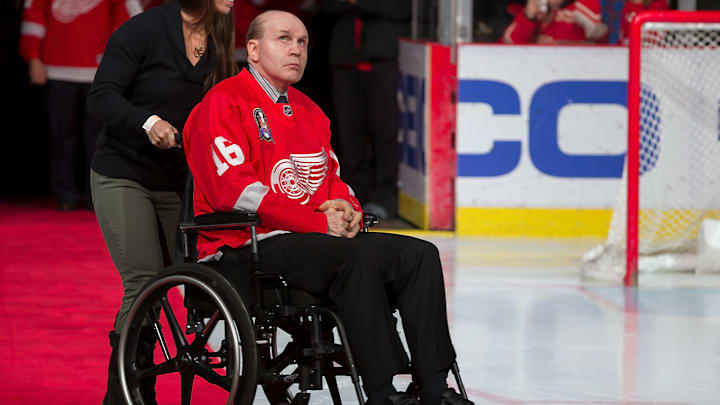
During Sergei Fedorov's jersey retirement ceremony earlier this week, a young Detroit Red Wings player—someone born long after the banners went up, long after Joe Louis Arena fell silent—looked across the ice and asked head coach Todd McLellan a simple, innocent question:
“Who’s the guy in the wheelchair?”
Not out of disrespect. Not out of indifference. Out of honesty.
And in that moment, the weight of Red Wings history showed itself in a way no stat line ever could. Because the guy in the wheelchair is Vladimir Konstantinov.
He is No. 16. He is “Vladdy.” He is the human embodiment of sacrifice, resilience, and the thin line between triumph and tragedy.
Less than a week after the Red Wings finally climbed the mountain in 1997—after Konstantinov threw his body into every check, every corner, every shift to help end a 42-year Stanley Cup drought—his life changed forever. A limousine accident nearly claimed him and team masseur Sergei Mnatsakanov. Both survived, but neither was ever the same.
Konstantinov never played another NHL game. The hardest, most fearless defenseman of the Dead Wings era—nicknamed “The Russian Five’s hammer”—was suddenly fighting for something much bigger than the puck. And yet, he never left.
Konstantinov was there in 1998 when the team wheeled him onto the ice at Joe Louis Arena, the Stanley Cup placed in his hands as 19,000 people cried. He has been there in spirit every time Detroit talks about grit, heart, and what it means to wear the Winged Wheel.
That’s why no one has worn No. 16 since. It isn’t officially retired. It doesn’t hang from the rafters. But it’s his.
Sergei Fedorov's jersey retirement ceremony gave the young Red Wings some important history lessons.
— Brad Galli (@BradGalli) January 14, 2026
"I'm not going to tell you who, but obviously a little bit younger, but I had a guy ask me, who's the guy in the wheelchair?" McLellan said, speaking of Vladimir Konstantinov.… pic.twitter.com/HGz73vmyo5
Vladimir Konstantinov’s presence is still shaping Red Wings culture today
When a young player asks, “Who’s the guy in the wheelchair?” that’s not a failure of memory. It’s an opportunity. It’s the torch being passed. It’s a reminder that jerseys don’t just represent players—they carry stories, scars and souls.
The question matters because one day, that player will be the veteran. He’ll stand in a locker room full of kids who weren’t alive when this era began. And he’ll remember that there was once a man named Vladimir Konstantinov who gave everything he had for this crest—and paid a price none of us can truly comprehend.
That’s who “the guy in the wheelchair” is. He’s the reason this franchise understands that winning is precious. He’s the reason banners feel heavier. He’s the reason the past still breathes inside the present.
And as long as No. 16 remains untouched, Detroit will never forget him.
 Add us as a preferred source on Google