

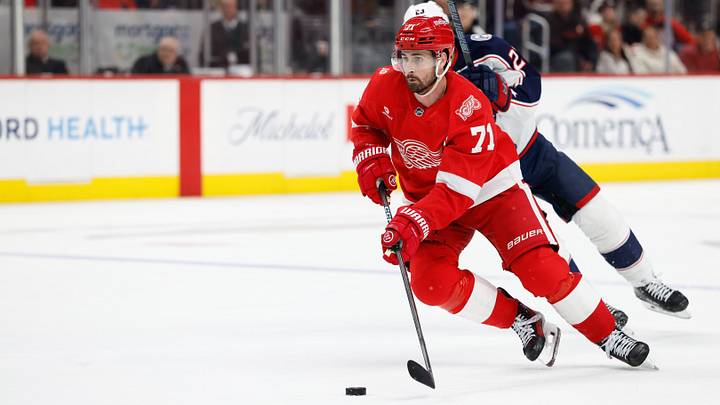
The Detroit Red Wings are a month away from training camp without a permanent general manager, a team captain who wants out, a prominent restricted free agent still needing a contract and a roster that is likely to finish at the bottom of the Atlantic Division.
With word coming out that the team is utilizing an outside search firm to vet potential GM candidates, Detroit has a laundry list of things to do for whoever the next general manager is. With the way competitive prospects are looking next season, here’s what they should focus on doing as soon as they step into their new office in Little Caesar’s Arena.

Get Simon Edvinsson’s contract done
Simon Edvinsson formed the second half of what was a dominant defensive pairing with Moritz Seider last season and, despite hardly any power play time, has shown a knack for contributing offensively as well. With the salary cap rising and Edvinsson’s best hockey theoretically ahead of him at 22-years-old, getting Edvinsson signed to a long-term deal is of paramount importance.
While I am not the biggest fan of Detroit’s prior tendency to treat their top player’s cap hit at the time as their max salary, there is something to be said about keeping Edvinsson’s cap number as close to Seider’s $8.55 million a year figure as possible. That said, it is entirely possible that Detroit may have to accept the reality of this new cap environment and pay their 2021 top-10 pick something in the $9-10 million range (or more) to lock him up for the long haul.
If I’m the mystery new Red Wings General Manager, I see if Edvinsson will accept something like seven years, $8.5 million per year to put him in the same range as Seider and Lucas Raymond, but move up a reasonable amount if necessary to get the deal done.

Trade John Gibson and Justin Faulk immediately
After a rough October, John Gibson had a resurgent season in net, recording a 2.72 goals against average and .901 save percentage. He also notched a .913 save percentage in his final 43 appearances of the year. Gibson’s performance, despite being a pending free agent, has spiked his value.
Justin Faulk was a trade deadline acquisition that, unfortunately, wasn’t able to put the Red Wings back into the postseason amidst yet another March swoon. He did soak up minutes, logging over 20 minutes per game and notching eight points in 17 games, but also logged a pretty rough 43.4% Corsi rating (and -7.3 relative Corsi) in his post trade performance in Detroit. That said, he is still historically viewed as a top-four defenseman with two-way value.
The problem Detroit faces with both is that Gibson turns 34 next summer and Faulk turns 35 in March, plus both are in the final seasons of their contracts. Given the increasing certainty that the Red Wings are taking a step back this season, neither player is likely to be on the Red Wings’ next competitive roster (which hopefully won’t be 10 years from now).
Detroit’s new General Manager should focus on trading Gibson and Faulk sooner rather than later to get as good of a return as possible. Faulk has a cap hit of $6.5 million while Gibson carries a $6.4 million cap hit for the season and the Red Wings, if necessary, hold all three of their salary retention slots for the season to create flexibility for cap crunched teams.
The Pittsburgh Penguins, who were a surprise playoff team a year ago and have their band of Sidney Crosby, Evgeni Malkin, Kris Letang and Erik Karlsson back in tow, could see if they can milk one more deep playoff run out of their careers. Quality veterans like Faulk and Gibson on expiring deals could make a lot of sense for the Penguins and having someone like Gibson gives Pittsburgh added insurance for rookie Sergei Murashov. Here’s my proposed move:
- Pittsburgh gets: John Gibson and Justin Faulk
- Detroit gets: 2027 Pittsburgh 1st round pick, Rutger McGroarty, Ryan Graves and Arturs Silovs
Rutger McGroarty is in a weird place as a prospect for Pittsburgh and is still trying to establish himself as an NHL center, but he has 32 games of NHL experience and played well during his AHL stint with 34 points in 30 games a year ago. At 22-years-old, he may be entering make-or-break territory, but he is a former first-round pick who has produced at every level except the NHL.
The Wings would also fetch an extra first-round pick and take on Ryan Graves’ buried contract and the now-superfluous Arturs Silovs to make the salary cap numbers work out for Pittsburgh and give Detroit a warm body in net to replace Gibson. With the dust settled on that front, the new GM should do some due diligence and address the franchise’s dominant storyline.

Trade Dylan Larkin and move on
For a young team trying to rebuild, having a captain who has expressed no desire to remain there is toxic in a number of ways. The list of teams Larkin is willing to accept a trade to has significantly condensed with Vegas, Dallas and Florida no longer expressing interest in trading for him. For now, that leaves only the Minnesota Wild, who previous GM Steve Yzerman could not come to a satisfactory arrangement with.
With five years left on his contract with an $8.7 million cap hit that is going to look increasingly like a bargain with each passing year and bump of the salary cap, Larkin is an insanely valuable commodity. While asking for a core piece like Matt Boldy is clearly not something the Wild will do, I think that the new Detroit GM should demand better value than simply late first round draft picks and middling prospects. If Detroit and Minnesota were to make something work, the framework of a deal should look something like this.
- Minnesota gets: Dylan Larkin
- Detroit gets: Joel Eriksson-Ek, Danila Yurov, 2027 First Round Pick
Note: This deal still leaves Minnesota $1.3 million over the salary cap for 2026-27.
The Wild have been wanting to bump Joel Eriksson-Ek down the lineup as a number two center for some time and may well balk at this move, but the fact remains Minnesota is only operating with $1.2 million in cap space. Asking Detroit to pick up anything on Larkin’s already bargain contract would be ridiculous and Eriksson Ek ($5.25 million per year for three more seasons) is the most expensive non-core forward the Wild have. Yurov is a young potential number two center, but he also looks like he may be a better fit in a bottom six role. Still, he offers the best upside among young Wild forwards and a first round pick is just table stakes for a Larkin deal at this point.
Any deal with Minnesota requires those three pieces just to start the conversation, but it won’t be enough as that still leaves the Wild roughly $1.3 million over the cap. Here’s where that can get interesting if the Wild want to make this deal work.
A way the Larkin deal can work
One of the Wild’s goaltenders, Filip Gustavsson is beginning a five-year deal at a $6.8 million annual cap hit and is coming back from offseason hip surgery. With the Wild still needing to make a pitch to re-sign superstar defenseman and Larkin bestie Quinn Hughes along with breakout goaltender Jesper Wallstedt, the Wild need to open up salary. Minnesota is ostensibly going for broke to win this year, but Gustavsson’s health may jeopardize that depending on his recovery.
Theoretically, Minnesota could put Gustavsson on long-term injured reserve and gain back enough cap space to make the above Larkin deal work, but that would still leave them having to figure out how to open up more space if Gustavsson is healthy down the line. It would be in the Wild’s best interest to send one more player back in the above move if they are set on acquiring Larkin:
- Olli Maata (2 years, $3.5 million cap hit remaining on contract)
- Filip Gustavsson (5 years, $6.8 million cap hit remaining on contract)
- Nico Sturm (1 year, $2 million cap hit remaining on contract)
Red Wings’ fans are familiar with Olli Maata’s solid, if unspectacular work in the mid to lower defense pairings of recent years. He is a perfectly tolerable presence and his return would probably be met well. However, he is not a long term solution for anything and his presence could block younger players from breaking into the lineup. The same could be said for perennial okay bottom six forward Nico Sturm. If Detroit were picking up either of those two, the new GM should demand either center prospect Charlie Stramel or Minnesota’s 2028 first round pick be added to round out the proposed Dylan Larkin trade.
Considering so much of Detroit’s future in net depends on Trey Augustine working out, I would personally push to get Gustavsson. He represents a risk due to how he recovers from surgery and his nearly $7 million cap hit is on the heavy side for the position. However, he has played at high levels in the past, including last year, and represents a potential long-term tandem partner with Augustine as he breaks in.
Minnesota is likely making this push for Larkin specifically as incentive to convince Quinn Hughes to re-sign with the team next summer. The Wild don’t have a lot of cap flexibility coming up and moving a contract like Gustavsson’s could help, especially as Wallstedt will be due a new contract next summer as well. If Detroit were to execute my proposed Pittsburgh trade I listed earlier, I think it would make sense to send Arturs Silovs back to Minnesota as an NHL caliber backup to Wallstedt. The Wild are likely going to need to find $25-30 million minimum in cap space to re-sign Hughes and Wallstedt, so I can see Gustavsson being deemed expendable given his recent health issues.
If Minnesota refuses to provide the above in return for Larkin, it is better to sit and wait it out until he expands his trade list to more realistic options on the market.
Should the trade scenarios I listed come to fruition, Detroit is slotted to still be bad this year and have a genuine shot at a lottery win for the chance to select Landon DuPont or any of the supposedly great crop of centers entering next summer’s NHL Entry Draft. The moves give them plenty of wriggle room to throw things at the wall at the center position while also searching for other trades to cash in on like Andrew Copp, or potentially Alex DeBrincat. While the lineup gets a few young centers and additional first round picks to have a chance to shine in elevated roles.
 Add us as a preferred source on Google