

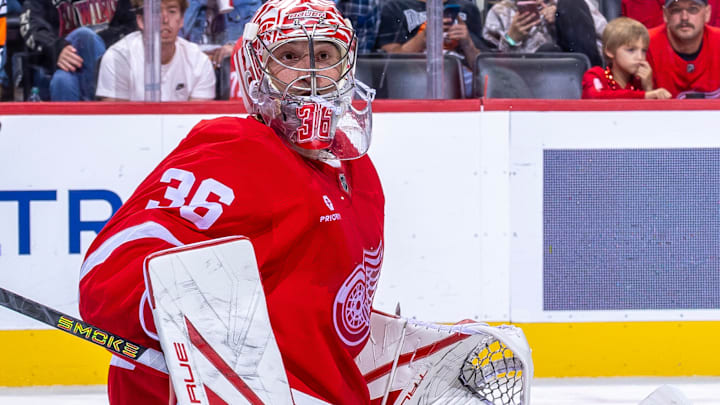
When the 2025-26 season started, the Detroit Red Wings had a simple plan at goaltender. The newly-acquired John Gibson would be the primary starter, and Cam Talbot would rotate in as the backup while Sebastian Cossa refined his game in Grand Rapids.
In theory, it looked like a great idea. Gibson's 2.77 GAA and 0.911 save percentage showed he could still live up to his $6.4 million cap hit, and the Red Wings needed at least a stopgap in the crease. So, with Lukas Dostal factoring in as the number one in Anaheim, the Ducks had no problem trading Gibson to Detroit for Petr Mrazek, a 2027 second-round pick, and a 2026 fourth-round pick.
The problem is Gibson has yet to show he was worth what the Red Wings gave up, struggling to a 3.31 GAA, a 0.875 save percentage, and just a 0.364 save percentage. With the Red Wings leading the charge in the Atlantic Division, it's not acceptable to struggle like this.
It's also worth pointing out that, in his last five games, Gibson finished with a save percentage higher than 0.882 just once. On Nov. 4, he saved 33 out of 34 shots on goal in a loss to the Vegas Golden Knights, and that's as good as it has gotten for Gibson all season.
John Gibson's recent history has a flurry of red flags
It's easy to excuse some of Gibson's subpar play with the Anaheim Ducks, since they spent a few years tanking before he ended up in Detroit. Still, the numbers speak for themselves. Between the 2019-20 and 2023-24 seasons, Gibson's quality starts percentage dipped below 0.500 in all but one season during that span.
While Gibson had a 0.900 save percentage or better in three of those five seasons, he also saw his GAA dip below the 3.00 mark just once. His final two seasons as the Ducks' number one goaltender saw save percentages of 0.899 and 0.888, respectively, along with GAAs of 3.99 and 3.54.
While he rebounded in 2024-25 with a 0.911 save percentage and 2.77 GAA, he was no longer in the Ducks' future plans. They moved on to Lukas Dostal, who has been a pivotal part of their youth movement and resurgence.
Gibson's most recent seasons show us that he hasn't produced well enough as the number one. He may have played for a bad hockey team, but for someone whose first four seasons as the full-time starter in Anaheim were nothing short of epic, Gibson underachieved. And given his numbers in 2024-25, he's best suited as a backup, even if he's still earning a starter's salary.
How the league may have outpaced Gibson
The NHL has become an offensive-friendly league, and that's the case now more than ever. When Gibson first entered the league in 2013-14, the goals per game average in the NHL was just 2.67 for each team. During his first full season in Anaheim in 2014-15, that number dipped to 2.66 per team.
In 2015-16, Gibson's first full season as a starter, teams averaged just 2.67 goals per game, and that increased to 2.73 in 2016-17. Starting in 2017-18, that number jumped to 2.93. And since 2021-22, that number has been, at worst, 3.01, which came in 2024-25.
Gibson's production nose-dived when the Ducks expected him to take most of the starts. Gibson was a great goaltender when the league didn't emphasize as much offensive skill, but when that trend started, Gibson's production slowly but steadily declined.
There was hope last season, and that prompted the Red Wings to make a trade. But as Gibson is proving, he can't keep up with the way the game is played today.
If the Red Wings weren't playing good hockey, then whatever, Gibson's poor numbers would be an afterthought. But with the Wings winning the Atlantic at the quarter-season mark, his job security must be at stake. He has a chance to correct that issue on Thursday night vs. the Islanders, but if he can't, it's time to relegate him to the backup role.
 Add us as a preferred source on Google