

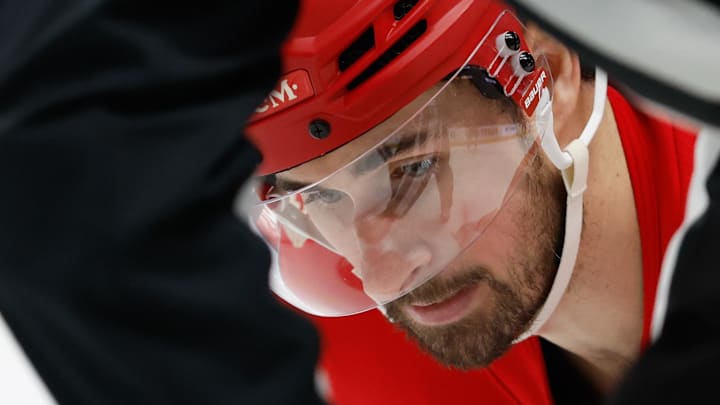
There’s a difference between being important and being indispensable. For the Detroit Red Wings, Dylan Larkin is both.
He drives transition. He sets pace. He tilts the ice. When the Red Wings need a push, it’s usually coming from him. Everyone in Detroit knows how hard he works and how much he is respected in the room. Now, the rest of the world will get an opportunity to see how his game scales on the international stage.
Larkin enters the Olympic tournament slotted as Team USA’s No. 3 center. He’s skating with Jack Hughes and Tage Thompson on the wing, behind lines centered by Auston Matthews and Jack Eichel. When you’re surrounded by guys like that, not to mention Brady and Matthew Tkachuk, Jake Guentzel, Matt Boldy and others, there’s no hiding behind “top-line usage” or “heavy minutes.” Everyone is elite. Everyone produces.
At the Olympics, the question isn't can you play? Everyone can. But can you dictate pace when the ice shrinks? Can you carry the puck against Sweden's layered neutral-zone structure? Can you win down the middle against Canada's depth? Can you create offense that isn't reliant on one or two guys carrying the load?
In the NHL, Larkin does all of those things. The Olympics will show whether he does them against the best in the world.
"I've probably been thinking about [making the U.S. Olympic team] my whole life."
— SportsCenter (@SportsCenter) January 3, 2026
Dylan Larkin will live out his dreams with USA Hockey at the Milan-Cortina Winter Olympics 🤩 pic.twitter.com/aRZP8lMeZE
Dylan Larkin has the Olympic stage to prove he belongs with the very best
In Detroit, Larkin’s impact is measurable. He's the team's captain. He has 51 points in 58 games. He’s second on the team with 26 goals. The Red Wings are a playoff contender.
But translation is everything. We’ve seen strong NHL players fade in best-on-best settings when pace increases and space disappears. The difference between NHL speed and international tournament speed can be suffocating.
At the 4 Nations Face-Off last year, Larkin thrived in a bottom-six role. That helped cement his Olympic spot. Now, the bar is higher.
But for Larkin, standing out at the Olympics doesn’t mean leading the tournament in scoring. It means winning neutral-zone races against other elite skaters, forcing controlled entries instead of dump-and-chase, driving possession shifts that tilt momentum, and being the center who makes his wingers better — not the one benefiting from them.
With Hughes and Thompson on his wings, this is going to be a fascinating evaluation environment for Larkin. Both are dynamic and able to create offense independently. If Larkin becomes the line’s pace-setter rather than its connector, that’s telling. If he dictates the tempo of shifts rather than reacting to it, that’s validation.
For years, Larkin has existed in an odd tier — too good to be doubted, but not universally recognized as elite. He’s been labeled a “very good No. 1 center” rather than a franchise-defining one. A strong captain. A fast skater. A reliable two-way presence.
But in the Olympics, you are either impacting games at a world-class level — or you’re a complementary piece. There’s no middle ground. And that’s what makes this tournament so compelling for Larkin specifically.
The Red Wings are sitting third in a tight Atlantic Division race at the break. They’re finally pushing toward relevance again. If Larkin dominates shifts internationally — if he looks like he belongs in the Matthews/Eichel tier — that reshapes his standing in league-wide conversations. It strengthens the case that Detroit’s resurgence is anchored by a truly elite center.
 Add us as a preferred source on Google