

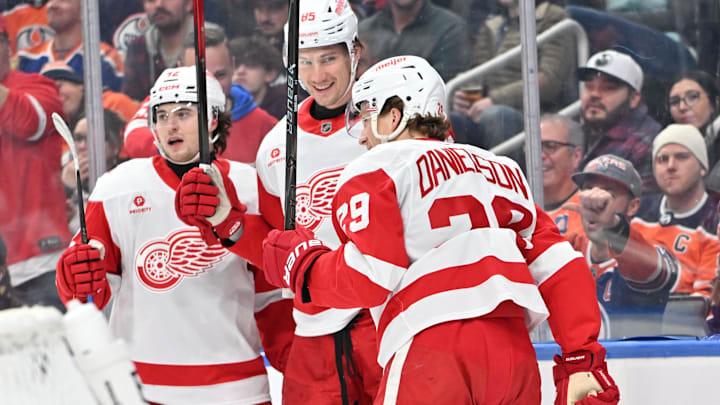
Going into their tenth year outside of the playoff picture, the Detroit Red Wings roster is in something of a state of transition as the new guard takes over for the old. At the moment, the veterans on the team comprise the majority of the top two lines, with the notable exception of Emmitt Finnie.
Finnie, a seventh-round rookie drafted in 2023, was the surprise of the Red Wings prospect camp and preseason, making the jump almost straight from the WHL to the NHL, something not often seen outside of top draft picks, and even then it’s not a guarantee.
However, that jump also displaced Marco Kasper, who had spent much of his rookie season last year splitting time between the top line on the wing opposite Lucas Raymond with Dylan Larkin at center, and on the second line centering Patrick Kane and Alex DeBrincat.
Kasper was moved back down to the second line, but outside of two early season goals, he hadn’t been able to register any offensive impact on the scoresheet for the team going into the second half of November.
Meanwhile, Nate Danielson, one of the Red Wings' first-round picks in 2023, spent the beginning of the season injured. Danielson, like Finnie, came out of the WHL, though he spent last year in the AHL with the Grand Rapids Griffins.
After rookie Micheal Brandsegg-Nygard seemed to fall behind after a strong preseason and start to the year, Detroit swapped the young forwards, and Danielson debuted for Detroit last month against the Chicago Blackhawks on Nov. 9th.
Centering focus for Nate Danielson
Though Danielson has gotten off to a somewhat slow start, the Red Wings have recently been playing him and Kasper on the second power play. Centering Kasper and the massive 6’8” Elmer Soderblom on the third line most nights, they’re the youngest line on the team by average age by a considerable margin. However, that youth shows exactly the kind of potential this team has.
Danielson has had three points in the last five games, Soderblom led the team in shot attempts on several nights during the Red Wings’ recent road trip, and Kasper finally broke his scoring drought as the secondary assist on Danielson’s goal in the game against the Vancouver Canucks. That came on a sequence of Danielson winning the face-off, Kasper firing it back to Axel Sandin-Pellikka, and Danielson tipping the puck past Kevin Lankinen. That all happened within 11 seconds of play.
There is, of course, a catch beyond the fact that this line’s production is already so low. The trio has combined for more than a few turnovers in games, and they are the most likely suspects to be out of position on a given breakaway.
Soderblom can either outmuscle his opponent or he can keep the puck out of reach with smart play, but trying to combine the two slows him down too much in many instances, and he still only has two points in 21 games. Before that assist in Vancouver, Kasper didn’t have one since the end of last season, and hasn’t had a goal in almost a month.
Learning on the fly
It’s a line that would probably benefit from being in Grand Rapids. At the moment, the Red Wings' AHL affiliate is dominating games and is performing some roster gymnastics in order to not breach the AHL’s veteran players rule.
Kasper, Soderblom, and to a lesser extent, Danielson, are all young players struggling to find the net. Most nights, they’re not playing for more than 12 minutes on the ice in the NHL.
But the reality of the situation is that the Red Wings need them to develop now, and they don’t have the luxury to do it in a more sheltered environment like the AHL. This line consists of some of the team’s youngest players, and they’re learning in a trial by fire this season that the big leagues require you to bring a bigger, more aggressive game if you don’t want your spot taken by someone taken six rounds behind you.
 Add us as a preferred source on Google