

It is not a hot take to suggest that the Detroit Red Wings’ indecisiveness at an organizational level is killing their brand and their credibility. What goes overlooked, though, is how deep that rabbit hole actually goes.
The Red Wings are an organization that touts their history and heritage as an Original Six franchise amid a decade-long playoff drought. While they point to the accomplishments of their past, they are falling backwards and watching other organizations – organizations that some Red Wings fans like to compare championships with like some sort of measuring contest – pass them by.
Nobody cares that you have 11 championship banners when you haven’t made it past the first round of the playoffs since 2013. It’s a “what have you done for me lately” league, and lately all the Red Wings have done is lay rakes throughout their yard and then wonder why they keep smacking into rakes.
If the Red Wings don’t take an honest look at themselves and grasp all the decisions – or lack thereof – that led them here, they will continue to step on those rakes and make a mockery of the heritage they claim to cherish.
Delaying key decisions at an organizational level
It’s become a clear pattern this season, but the Red Wings have been kicking the can down the road for a while now.
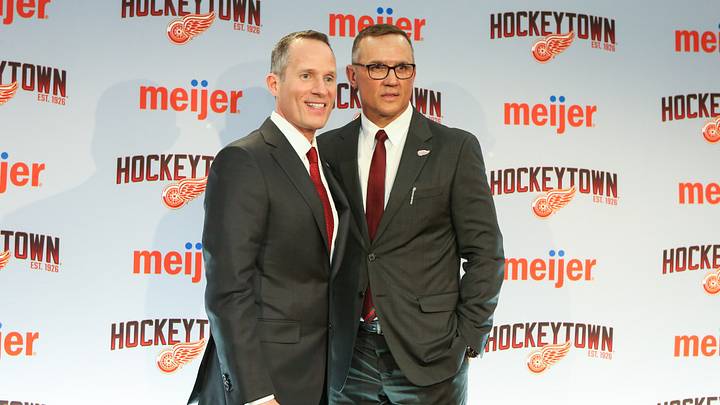
Over the last few months, we’ve witnessed the Red Wings organization delay dismissing general manager Steve Yzerman until midway through July, delay taking decisive action on Dylan Larkin’s trade request as the organization apparently prefers to exhaust every option they have to keep him, delay speaking to Simon Edvinsson about a new contract until weeks before the start of the season, and overall delay accepting the fact that their roster is fundamentally flawed.
Before that, we saw the organization delay dismissing head coaches Jeff Blashill and Derek Lalonde even though it was clear change was needed; the “fire Blashill” chants that filled Little Caesars Arena back then almost seem to echo the “sell the team” chants already heard this season – both born from frustration and eroded patience.
We saw the Red Wings delay working out new contracts for Moritz Seider and Lucas Raymond – the crown jewels of their rebuild – until the weeks of training camp; despite his importance as the team’s top defenseman, Seider had to miss the start of camp due to ongoing negotiations. The recent example of Edvinsson is worse as he attended camp without a contract and still missed the start of the season as negotiations are ongoing.
Can you blame Edvinsson for getting frustrated?
But wait, it goes deeper than that.
Cossa & Lombardi victims or Detroit’s delays
We saw this organization delay seeing their prospects at the NHL level. There is something to be said for not calling up a player before they’re ready, but at some point, it just becomes bad asset management. Sebastian Cossa played all of 45 minutes in a Red Wings sweater – and even recorded his first victory in that appearance – before the organization decided it was prudent to trade the goaltender they traded up to draft at 15th overall back in 2021.
There were opportunities along the way for Cossa to get a game here or there. He was named an all-star in the American Hockey League twice; despite his late-season nosedives, he did enough before then to warrant more than 45 minutes of the Red Wings’ time – but the organization was content to kick that can down the road too.
Cossa may never be the goalie Detroit envisioned when they drafted him. If he does reach that level, however, he will do it wearing a Utah Mammoth sweater.
Amadeus Lombardi struggled with staying healthy over the last two seasons, playing just 91 games with the Grand Rapids Griffins. However, the tenacious forward recorded 82 points in that time, a scoring pace that clearly suggests a player might be ready to take the next step. The Red Wings were always willing to delay that next step until they eventually traded him to the New Jersey Devils for a fourth-round pick.
While Lombardi doesn’t project to be a first line talent in the NHL, Devils were the ones willing to give him his shot, not the Red Wings. For an organization that is eager to get their young core in place so they can truly start building a contender, you would think the Red Wings would have more urgency about seeing what their top young players can do in the NHL.
There certainly are other examples of the Red Wings delaying decisions, big and small. The pattern is undeniable: this is an organization that would rather be too late than too soon. When Yzerman used to preach patience regarding the pace of Detroit’s rebuild, fans likely understood it to mean that prospects take time to develop, and you need to give them the time to do that. What they couldn’t have known is that their patience was required because the organization would slow-play every major decision they encountered along the way.
DeBrincat & other situations coming up
The Red Wings’ overall lack of urgency has almost certainly cost them talent along the way. There are disputed claims about the Red Wings hesitating over signing Steve Stamkos when he was a free agent in 2024. There was also a report that the Red Wings were on the verge of bringing Anthony Mantha back to Detroit in the aftermath of Yzerman’s dismissal, but ownership paused, and Mantha opted to join Lombardi and the Devils.
More decisive action following Larkin’s trade request may have resulted in Patrick Kane staying in Detroit as well. A day after signing a two-year pact to rejoin the Chicago Blackhawks, he went on a podcast and mentioned that he originally expected to re-sign with the Red Wings. It’s fair to suggest that the uncertainty in Detroit ultimately pushed him out the door and back to Chicago.
With that in mind, the Red Wings have key decisions looming on the horizon even after they deal with Larkin and Edvinsson. The biggest one pertains to Kane’s old running mate, Alex DeBrincat.
After effectively forcing his way to Detroit via trade with the Ottawa Senators, DeBrincat signed a four-year deal with the team he grew up cheering for. Since then, he has 107 goals and 223 points in 249 games; he was also the first player since Marian Hossa to score 40 goals in a season for the Red Wings. He turns 29 years of age in December and figured to be a crucial part of Detroit’s offense for as long as he wears the winged wheel.
DeBrincat is scheduled to become an unrestricted free agent in July, pending an extension with the Red Wings. The problem is that, as we have seen with the Edvinsson negotiations, not only is Detroit likely to delay deciding on DeBrincat’s future, but the projected value of his next deal may be a number Red Wings ownership is uncomfortable with. In today’s salary cap climate, a scoring winger like him could get upwards of $12 million a year on his next deal.
The only reason for delaying is if the Red Wings are considering the possibility of using DeBrincat as trade bait to rejuvenate their system with additional future assets. But considering they’re dealing with a homegrown talent that actively wants out of the organization, it would be tough for fans to say goodbye to a homegrown talent like DeBrincat that wants to stay. His number isn’t likely to go down, though, and kicking the can down the road may result in the player not feeling like a priority.
Aside from DeBrincat, the Red Wings will also need to sort out their goaltending situation for next season as John Gibson and Daniil Tarasov are both set to become free agents in July. The organization probably needs to decide on an overall direction before figuring out what their goalie tandem will look like in 2027-28, but it’s still a situation to monitor, nonetheless.
Marco Kasper will also need a new deal as his entry-level contract will expire in July. There is good reason for the organization, the player and his representation to put this situation off until at least the new year; he has had an uneven first two seasons in the NHL, so it would benefit Kasper to use this season to make his case for a bigger payday.
This situation is different from Edvinsson’s and others, but Kasper seems to be the young center the Red Wings have the most faith in, so getting him signed as soon as possible should be an organizational mandate.
If things are going to be different moving forward, the Red Wings will have ample opportunity to prove it.
Red Wings must adapt
You don’t need to watch a nature documentary to understand that you either adapt or you die. In fact, the current state of the Red Wings is proof of it.
They failed to recognize the game is trending younger, and now they have a roster featuring several players that are essentially expensive roadblocks for younger players looking to make the leap to the NHL.
They failed, time and time again, to recognize that you often save money and save face by locking up your young talent sooner rather than later.
Perhaps most importantly, they failed to recognize that in today’s world of instant communication, fans expect transparency – especially when those fans are enduring the worst era of Red Wings hockey since the “Dead Wings” era.
The Red Wings’ history is what sets them apart from almost every other franchise in the league. It’s why they are one of the most recognizable brands in all sports. The problem is that the organization seems content to imprison themselves in that history rather than write a new chapter.
This is the same franchise that revolutionized the sport with the Russian Five. The first European captain to lift the Stanley Cup did it in a Red Wings uniform. The Red Wings of old knew that staying competitive meant staying ahead of the curve. The Red Wings of today must decide if they want to make history or if they want to become it.
That’s a decision they can’t kick down the road much further.
 Add us as a preferred source on Google