

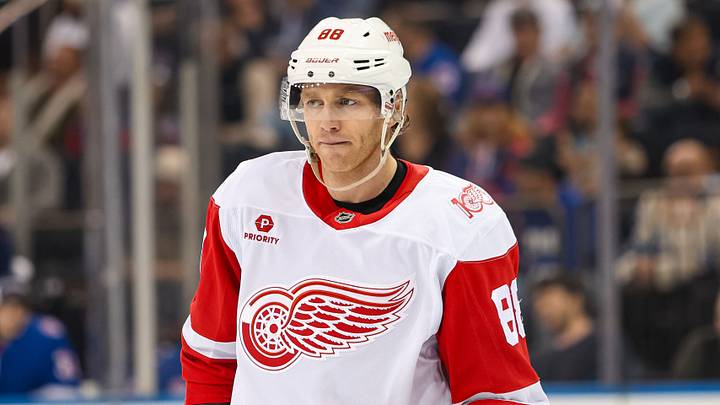
Losing Patrick Kane was one of the biggest hurdles the Detroit Red Wings had to overcome this offseason.
Between losing Kane and James van Riemsdyk, many wondered where the Red Wings would be able to replace the offense. After all, Kane finished last season fifth in team scoring and van Riemsdyk capped off the season with 15 goals. Scoring forwards don't exactly grow on trees in the NHL, and the Red Wings already finished the 2025-26 season with a negative goal differential.
Fortunately, it appears that concerns over the departure of Kane (and van Riemsdyk, for that matter) were unwarranted.
New free agent signee Viktor Arvidsson has more than delivered on his two-year, $5M/year contract thus far, starting the season off with an impressive 10 points in 12 games. Arvidsson, 33, joined the team this offseason to help the offense regain some even-strength scoring -- something they sorely missed in 2025-26.
But Arvidsson isn't the only player to deliver offensively.
Michael Brandsegg-Nygard has established himself as a premier threat on the Red Wings' offense, generating eight points in 12 games with the Red Wings so far. He's second in rookie scoring and first in hits, delivering a record-breaking team-best 11 hits on Monday's game against the Edmonton Oilers.
While losing Kane stung at first, the decision might wind up being the best in the long run.
Why the Red Wings are better off without Kane
Kane, 37, still has what it takes at the NHL level, putting up seven points in 11 games with the Chicago Blackhawks thus far. On the Red Wings, he'd be sixth in team scoring behind Michael Bransegg-Nygard, Emmitt Finnie, Viktor Arvidsson, Lucas Raymond and Alex DeBrincat.
It should go without saying that having both Kane and Arvidsson would be a boon, but bringing Kane back for another year would've had a ripple effect on the rest of the roster. When Kane was with the Red Wings, they relied on him too much offensively, keeping him glued to the top-six at all possible times.
If this trend continued, Michael Brandsegg-Nygard would have to make the most of the third line alongside Andrew Copp and Michael Rasmussen. This, in turn, would both limit his minutes and his offensive production. While the idea of moving Kane to the third line makes sense in theory, the Red Wings failed to do so last season when it was clear Kane wasn't playing at the highest level.
Additionally, while Kane is still a very effective offensive producer, the team had to adjust their entire scheme to fit around his speed (or lack thereof). Players like Emmitt Finnie, who rely on their speed to produce, would have their offensive abilities kneecapped to accommodate for the veteran. Players like Alex DeBrincat can adapt, but for others, it means making concessions to their play style.
This is a luxury the Red Wings can't afford right now.
Red Wings embracing younger, faster players
Patrick Kane will be 39 by the time his contract with the Blackhawks ends. While still capable of putting up points, his current play style isn't conducive to developing a young core. The Red Wings, since Kane's departure, have embraced somewhat of a youth movement, bringing on Brandsegg-Nygard, William Wallinder, Axel Sandin-Pellikka, Anton Johansson and Michal Postava, while giving increased responsibilities to Emmitt Finnie.
It's bittersweet to say farewell to a legendary veteran -- especially one that was with the team for years. But, in the long run, this will prove to be beneficial for both Kane and the Red Wings. Kane gets a hero's welcome in his twilight years in Chicago, while the Red Wings get a huge opportunity for their younger players.
 Add us as a preferred source on Google