

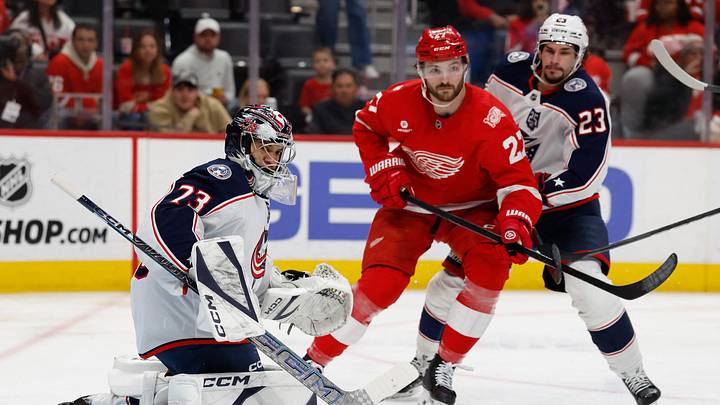
Michael Rasmussen finally got a point last Thursday. He ended a 31-game drought with the pass to Andrew Copp on the game-winner against Philadelphia, which gives him two assists in nine games this season. Todd McLellan said afterward that Rasmussen has "held up his end of the bargain."
I'm not buying it.
I've watched Rasmussen for years, and the player on the ice and the player in the spreadsheet look like two different people.
What the eye test says
Last season Rasmussen had 14 points (six goals, eight assists) in 64 games. He averaged 12:39 a night, his lowest since his rookie year. He was a healthy scratch a couple of times, then finished the year with 25 straight games without a point. He finished last season with one of the worst offensive ratings in the league, and over at The Grind Line Podcast, we gave him a D as a postseason grade.
Long stretches go by where you forget Rasmussen's out there. When you do notice him, it's generally for sloppy play, a bad turnover or his inability to hit anyone despite his large frame. If I'm yelling at the TV, there is about an 80% chance it is due to him.
What the underlying numbers say
The underlying stats at 5v5 tell a different story. Last season Rasmussen generated 0.61 expected goals per 60 minutes and scored 0.27 per 60. His shooting percentage was 5.56%, and the shot quality he took suggested it should have been something closer to 12.7%. The year before, it was more of the same, with 0.76 expected goals per 60 and 0.50 actual, according to Puckalytics.

The on-ice results look similar. With Rasmussen on the ice last season, Detroit controlled 45.5% of the expected goals but only 37.5% of the actual goals. That is an eight-point gap. This, in turn, resulted in the Red Wings becoming one of the worst teams at finishing in the league.
This year follows the same track in a tiny sample. Through nine games, he has no goals on 10 shots. With Rasmussen on the ice, Detroit has a 47.4% 5v5 expected goals percentage.
Detroit's expected goals share was about four points worse with him on the ice than without him. The numbers say he has been unlucky, but even then, the numbers are still below average. That's the reality of the situation.
Where the size shows up (or doesn't)
Rasmussen is 6-foot-6 and weighs in around 220 lbs. His hits fell from 141 in 2024-25 to 64 last season. This year he has 19 through nine games -- about 2.1 a night. McLellan has called him more physically involved. I'll give him credit for that; even if the hits don't come in key moments, they are up for now.
Size at that level, however, should also show up around the net. Rasmussen took 99 shots in 2024-25 and 65 last season. This season he has 10 -- roughly one shot per game. A 6-foot-6 center who takes one shot a night is giving up one of his biggest advantages. He's hitting more, but the shot count says he spends very little time focusing around the net. He should take a note from Michael Brandsegg-Nygard: you can bring the boom with both the body and the stick. Shoot more or scrum in front of the net, and the numbers are bound to go up.
The minutes are going up anyway
Rasmussen is averaging 16:55 a night, up from 12:39 last year. His power play time jumped from 14 seconds a game to 1:38. He also takes 42.5% of the team's penalty kill time, up from 32.3%. McLellan said they aren't going to evaluate him on points, and that's his call to make, but if you don't count on him for points, his other attributes still leave much to be desired.
Those minutes could go to Carter Mazur or Nate Danielson. The kids need the shifts more than a 14-point forward does.
My verdict on Rasmussen
Based on raw numbers, there should be more production here. A player whose shot quality suggests a 12.7% shooting percentage should not shoot 5.6% forever, especially because his career shooting percentage is 10.5%. I could see him scoring 10 this year if he keeps getting the looks. But are 10 goals, offset by sloppy play, really worth it? That's up to McLellan, but my vote would be no.
No matter what I might think, the reality still stands: Rasmussen has to take more shots. Give me two or more shots a night, heavy hits, a body at the crease and rebounds off his stick. Until I see that, Rasmussen is a fourth-liner at best and an extra at worst. Give the ice time and power-play minutes to the kids.
 Add us as a preferred source on Google