

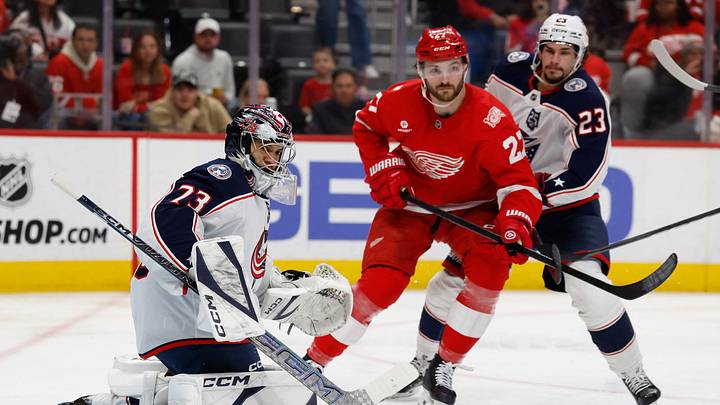
The bar is on the floor for Detroit Red Wings veterans.
Of course, players like Moritz Seider, Alex DeBrincat and Lucas Raymond are playing well, but they're more exceptions to the rule than anything. As far as the other vets go, there's not a whole lot to get excited about. Justin Faulk is playing very well in a small sample size, but players like J.T. Compher (pre-injury) and Ben Chiarot leave a lot to be desired.
The biggest surprise this early on, though, is Michael Rasmussen.
The former first round pick is the second-longest tenured Red Wing on the roster behind ex-captain Dylan Larkin. While he has yet to score a single point this season, he's been trusted more and more with each passing game. In a small, three game sample size, Rasmussen holds the sixth-highest 5v5 expected goals percentage in the league.
I’m sorry does that say Michael Rasmussen
October 6, 2026For those uninitiated in the world of advanced analytics, this means that the Red Wings possess the puck more and control play more when Rasmussen is on the ice. This, in turn, has translated to more ice time for Rasmussen. Here's what his deployment looks like across three games:
Game | TOI |
|---|---|
October 2 vs. NYR | 14:54 |
October 4 vs. WPG | 16:09 |
October 6 vs. OTT | 20:05 |
This precipitious increase in ice time can be attributed to two things: one, to injuries to players like J.T. Compher and Marco Kasper, and two, to Rasmussen's puck possession abilities early on.
Whether this is sustainable is anyone's guess. But it's clear that, for now, the Red Wings are giving Rasmussen a new lease on life.
McLellan hopes fresh start motivates Rasmussen
Before the start of the season, head coach Todd McLellan talked about Rasmussen's role with the Red Wings moving forward:
"He's got a fresh start to a new season; he's smart enough and mature enough to understand that," McLellan said. "He's just gotta capture it and stay confident, and that comes through in his play."
McLellan then went on to stress the importance of Rasmussen's physicality and tenacity. "He's a big man and can hold on to pucks well, and he can play heavy along the boards. That's what we're asking everyone to do."
Last season was Rasmussen's worst in terms of pace and production. In 64 games with the Red Wings, the former first rounder managed a measly 14 points. In 457 career games, he has just 154 points, good for 20th among all draftees in 2017. When asked about what the team needs from Rasmussen, McLellan was quite clear:
“The abrasiveness and heaviness; he'll have to be a good penalty killer for us to have success."
As of right now, Rasmussen handles penalty killing duties on the first pair alongside Andrew Copp, Albert Johansson and Moritz Seider. Last season, the Red Wings held the 23rd best penalty kill in the league at a 77.1 percent success rate. They'll need all the help they can get from Rasmussen if they hope to bring that number up.
If the Red Wings can keep getting crafty with their line combinations - and if Rasmussen can keep this up - the team should be in good shape moving forward.
 Add us as a preferred source on Google