

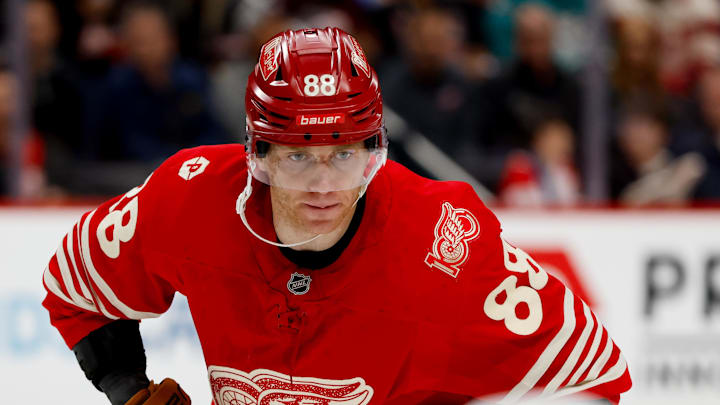
The Detroit Red Wings have been in, not just a playoff spot, but a divisional seed for most of the 2025-2026 season. While they remain in the same position, things have gotten bumpy. The dreaded month of March has arrived.
Throughout the season, Detroit's five-on-five scoring has been a problem. Earlier in the season, they were always able to fall back on their power play to keep them afloat. The Red Wings power play, until recently, was near the top of the league. In their last 20 games, however, they've gone 10-for-61 on the power play. This to show just how good it was for most of the season.
RAYMOND 🚨 Fantastic setup by DeBrincat and Kane as the Red Wings regain the lead on the power play. #LGRW pic.twitter.com/V1DM9SPTTH
— Ryan Hana (@RyanHanaWWP) January 11, 2025
So what's going wrong with the power play, and how can it be fixed? Let's see if I can figure that out.
What's wrong with Detroit's power play?
Why are the Red Wings struggling to not just convert on chances, but to also consistently get pressure? Simply put: they're too predictable.
The first power play unit's system revoles around getting the puck to Patrick Kane or Lucas Raymond. Then they wait, and wait, then pass it back to Seider on the point, then cycle between the point and flanks while Larkin sits in the bumper waiting for the puck. They wait for the perfect shot and never try to put the puck on net. Most NHL-caliber penalty kills can read their movements like a book and have been able to break up their break-ins and their setup effortlessly.
The second power play unit's problem is that it doesn't have an identity. The first unit at least has high-skill and speed to overwhelm their opposition. The second unit doesn't have a lot of either. Sure, you have Axel Sandin-Pellikka or Justin Faulk on the point. But your forward group is some combination of Marco Kasper, Emmitt Finnie, James van Riemsdyk or Andrew Copp. There is just no consistent identity on that unit.
Personnel changes could fix the power play
The Red Wings' regular power play units are Larkin, Raymond, DeBrincat, Kane, and Seider on the first unit and Copp, Kasper, van Riemsdyk, Compher and Sandin-Pellikka on the second (though Finnie and Johansson rotated in on occasion). Even with this rotation, the unit still struggles to generate effective offense.
The first change should be to take Patrick Kane off the top unit. His best weapon is playmaking, which he still does very well, but the team has Lucas Raymond. Raymond is much better at playmaking at this point in his and Kane's respective careers.
Taking Kane off this unit opens a spot for a net front presence. For most of the season, the top unit didn't have a net front presence. van Riemsdyk and Finnie spent some time there throughout the season, but largely they've been making do with quick flyby screens from DeBrincat or Larkin. But that takes away your two biggest shooting weapons, which really limits your ability on the power play.
We need to have an uncomfortable conversation about Patrick Kane on the power play
— Jake (@313Hockey) March 8, 2026
For this, you really have two primary options in Emmitt Finnie and James van Riemsdyk. If it were up to me, I'd put van Riemsdyk in this spot. He knows what to do, how to do it, and is very good at it. This forces the opposing penalty kill to commit a man to covering the net front, which in turn would relieve pressure on Larkin in the bumper, as well as open the ice for Raymond to move around, and let DeBrincat find some more open space on the flank.
Shuffling on the second
The second unit requires a bit more shuffling around; there are a lot of guys left on the team who all fill the same archetype. This is where Patrick Kane comes in. He gives the second unit that playmaking spark they've needed. This gives him matchups against opposing teams' weaker penalty kill units. Obviously, you keep Faulk on the point, then you can place Brandsegg-Nygard on the flank opposite Kane. He's got one of the best shots on the team, and if you give him enough space to work, he'll make the opposing team pay.
But how do you give them that space? You put Emmitt Finnie on in the bumper and Marco Kasper net front. Both guys aren't afraid to use their bodies to not only make room, but also not be moved so easily. This forces defenders to choose whether to commit to pressuring the flanks and point, or collapse to cover the slot and netfront, giving the flanks and point free rein to do whatever they want.
These are two solid units with similar strengths but used in different ways, making it hard for teams to plan against them on the fly. The first unit has speed, skill, shooting power, and one of the best net front presences in the league. The 2nd unit has the same thing, but instead of the high-speed, they have the size to make things a living hell for opposing penalty kills to try and deal with along the boards, and none of them get bumped off the puck easily.
 Add us as a preferred source on Google