

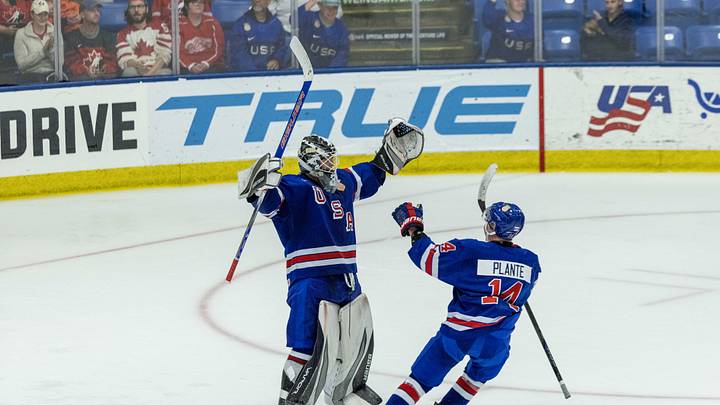
The Detroit Red Wings have a few players at the IIHF Men’s Ice Hockey World Championships -- seven in total, in fact.
Out of all the countries that participated in the Four Nations a couple seasons ago, only Team Canada and Team Finland have a perfect record. Team USA finds itself in fifth place in Group A. In Group B, we find Team Sweden in the same fifth place spot with just one win to show between the two countries.
Moritz Seider and Team Germany are still looking for their first win.
Of course, it’s not a juggernaut of a tournament. Canada has the most prolific names, while Sweden has Lucas Raymond and Czechia has former Red Wing Filip Hronek. For context, Jesse Pulujärvi and Sven Andrighetto (a 33-year old former third round pick of the Montréal Canadiens) are the leading scorers of the tournament with three goals and two assists each.
Raymond has five points as well in the tournament, but two goals and three assists.
It's safe to say that this annual summer tournament isn’t something to put much stock into, but it’s a fun tournament to watch.
Team USA captain, Justin Faulk, provides consistentcy
In Game One (a 3-1 loss against Switzerland), Faulk received player of the game honors:
Justin Faulk named player of the game for U.S. Leonardo Genoni for the Swiss.
— Chris Peters (@chrismpeters) May 15, 2026
Faulk saw 22:55 time on ice with 29 shifts and an average of 47 seconds. He recorded no shots on goal and was an even rating.
In Game Two, a 5-1 victory over Great Britain, Faulk skated in over 20 minutes of ice time (25 total shifts with an average of 48 seconds). He had five shots on goal and a +3 rating.
With Game 3, a 6-2 loss to Finland, Faulk earned his first assist of the World Championships in almost 20 minutes of ice time (22 total shifts, averaging 54 seconds) and a +1 rating. While a +1 rating may not seem all that intriguing at first glance, it’s worth noting that Faulk was the only positive rating among the Americans. Every other Team USA player was even or a minus for the game.
In his three games thus far in the World Championships, Faulk has been a steadying presence for Team USA. He’s clearly earned the trust of his coaching staff as he’s played the most for Team USA in each game.
While he won’t blow anybody away, having Faulk as a reliable presence on the world stage can give Red Wings fans some comfort as are bystanders on the first day of the 2026 NHL Entry Draft.
Max Plante showing his skills at the World Championships
The opening game of the World Championships had Hobey Baker winner Max Plante, on Team USA’s top line. An impressive feat for such a young player, even if he ended up moving down the lineup. Plante had a 16:23 time on ice with 20 shifts and averaging 49 seconds with a -1 rating.
In Game Two, Plante saw a slight decline in ice time with just shy of 15 minutes played in 16 total shifts and was an even rating.
In his third game, Plante’s ice time declined further to just over 12 minutes with 14 total shifts and an average of 52 seconds. He was an even rating as well, which is saying something positive about his game as nine players for Team USA ended the game with a minus rating.
No matter the shits Plante takes, the fact that he’s at the World Championships at all speaks volumes about his career thus far.
It also makes the fact that he is returning to the University of Minnesota-Duluth for another season more digestible. This World Championships have given him great challenges and might expose some opportunities that he can work through/improve during this collegiate season.
It will be interesting to see where he begins in 2027-28.
Moritz Seider can’t catch a break
While some players are off on vacation, Red Wings assistant captain is continuing to log over 21 minutes of ice time per night for Team Germany.
In Game One, Seider played in an eye-popping 25:02 minutes on ice in 34 shifts averaging 44 seconds. He recorded two shots on goal in a 3-1 loss to Finland.
Germany's Game Two was much of the same with over 26 minutes in 27 shifts averaging 58 seconds. In the 2-0 loss to Latvia, Seider had a +1 rating.
Then, in Game Three, Seider recorded four shots on goal and a -1 rating in a 6-1 loss to the host country, Switzerland. Getting a bit of a break, Seider skated in just 21:33 minutes of ice time (33 shifts, averaging 39 seconds).
Not quite sure what Seider must have done in a past life, but the elite, Norris-worthy (even MVP-worthy) talent continues to find himself on teams that struggle (through absolutely no fault of his own).
Seider continues to excel in his role as an elite two-way defenseman, and is a great fill-in for his goalie when called upon.
 Add us as a preferred source on Google