

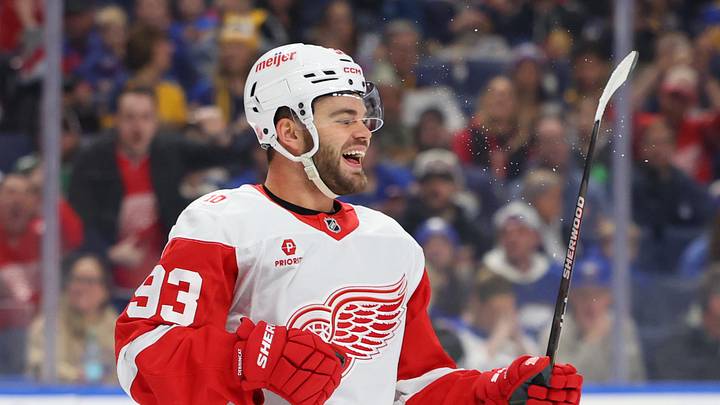
With the shock of Detroit Red Wings’ captain Dylan Larkin’s trade request last week becoming easier to swallow, especially as his list of teams he would accept a trade to has reportedly expanded from three teams that depleted themselves for Stanley Cup runs that came out initially, this offseason is proving a fork in the road for general manager Steve Yzerman.
Larkin is entering his age-29 season and, despite putting up five-straight 30-goal campaigns, has been part of each Detroit squad that has missed the past 10 postseasons. As the team captain and face of the franchise, Larkin is going to draw considerable interest due to his production and team-friendly contract ($8.7 million per season for the next five years) in a rising salary cap. Should Yzerman deal Larkin, the return on that trade will define his rocky tenure overseeing the Red Wings’ rebuild.
Assuming Larkin does suit up elsewhere in 2026-27, Detroit needs to focus on restructuring this roster quickly around the remaining core players. If Yzerman is smart, Larkin won’t be the only marque forward he sends elsewhere this summer.
As DeBrincat enters the final year of a four-year contract that carries a reasonable $7.875 million cap hit, the Red Wings need to decide whether they should lock him up to a long-term deal before he hits free agency, play out this season hoping he can net them their first playoff berth since 2016 (after dealing Larkin), or trading him this summer to max out his value and let someone else offer him a long-term contract worth north of $10 million per year when he turns 30 the season the deal starts.

Why Yzerman should trade DeBrincat
In an era where fewer impact players want to come to Detroit, it seems counterintuitive to deal away a forward who forced his previous team’s hand to come to the Red Wings. Having top players who want to be here has value and can make it hard to move on. DeBrincat has seen his production jump every season in his hometown return, netting 107 goals in 246 games with the Red Wings and matching his career best with 41 goals last season (while setting a new personal high of 85 points). He has scored 40 goals three times in his career despite his slight 5-8 stature. He has also been among the most durable players in the league, playing in all 82 games in seven of his nine seasons.
Despite the accolades, there are some problems that keeping him around presents. While he has shored up that area of his game, DeBrincat’s size and relative lack of speed are issues that are not likely to improve as he ages. The more likely scenario is that Detroit is enjoying the peak of his individual success, and with a similarly aged Larkin likely heading out, the time to reshape the roster to meet the competitive timelines of Moritz Seider and Lucas Raymond is now.
Keeping Alex DeBrincat after dealing Dylan Larkin is foolish
Detroit has had three runs with DeBrincat and Larkin on the team and blown a postseason spot in March all three times. That isn’t specifically blaming those players, but it is showing that Detroit’s current core is not good enough to push them back into Stanley Cup contention.
There is no Dylan Larkin trade to a contender that leaves the Red Wings’ roster in better shape when the dust settles, but that doesn’t mean they have to sit and wait to be just a little bit worse than a team that has been just shy of making the last three playoffs. Keeping DeBrincat and paying him an eight-figure long-term deal is a move that sets Detroit up to fail as he ages, even if the prospects in the system start to work their way onto the roster.
Rather than spinning his wheels trying to find that ever elusive postseason appearance as DeBrincat plays out the string of his contract, Yzerman should instead aggressively shop DeBrincat to anyone in the league who could use an established scoring winger (ie: everyone).

What DeBrincat could get for Detroit
Any rising team could use a scorer like DeBrincat. Anaheim, fresh off a second-round playoff appearance, has a boatload of cap space and some center depth. While they have young scoring wingers like Cutter Gauthier and Bennett Senecke in tow, adding a DeBrincat would make them even more formidable and allow them to prioritize their top restricted free agents and maybe deal an excess center.
Someone like Mason McTavish, a former high pick who has plateaued in his development, could be a welcome addition to Detroit and someone who can get one more crack at proving himself to be a number one center after Leo Carlsson took the reins for the Ducks last year.
While the price tag to re-sign DeBrincat will be high, cap-strapped contenders like Dallas or Vegas could be viewed as a shorter-term alternative to forking over longer-term and bigger dollars to younger restricted free agents such as Jason Robertson or Pavel Dorofeyev. Even if it ends up costing some futures from the Wings to make up the value there. Even a surprise playoff team like Pittsburgh may decide they are well served to add another pure goal scorer like DeBrincat for Sidney Crosby’s twilight years, which may fetch a prospect who showed promise like Ben Kindel.
Larkin trade request is a blessing
Dylan Larkin’s trade request, if played properly, could be the best thing that could have happened to Detroit’s agonizingly long rebuild attempt. Rather than figure out how to build around a rapidly aging Larkin and DeBrincat as fellow standouts Seider and Raymond start entering their prime years, they can choose to cash in on valuable commodities this summer, load up on talent that is aged more closely to the remainder of the core, and have even more assets in tow to still make a swing trade for someone like an Elias Pettersson.
This summer will be the most important of Yzerman’s tenure as the team’s GM. For the health of the franchise, he must not stop dealing with just Dylan Larkin.
 Add us as a preferred source on Google