

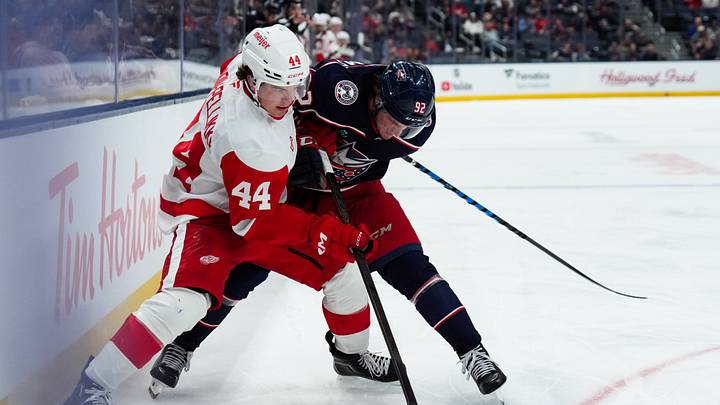
By all measures, Axel Sandin Pellikka’s 2025-26 rookie season was a success.
Following a strong 2024-25 season (12-17-29 line in 46 games) in Sweden, the offensive defenseman made a splash in North America by making the Detroit Red Wings out of training camp. The Gallivare, Sweden blueliner logged 68 NHL games, showcasing solid offensive chops in a support role. He finished the year with a respectable 21 points in 68 appearances as a 20-year-old.
Playing on the smaller rinks in North America and going through the grind of a long NHL season for the first time, ASP understandably faded some as the year wore on. He put up 13 of his 21 points during his first 34 games, logging at least 20 minutes in nine contests to that point. Afterwards, he saw fewer minutes with each passing month before eventually getting sent down to Grand Rapids shortly after the team traded for Justin Faulk before the trade deadline.

A tale of two halves for ASP
As a 20-year-old rookie defenseman, coaches are generally apt to pump the brakes Some of this was by design to ease him along to NHL competition, but the taper happened all the same.
Here’s a side-by-side look at Sandin Pellikka’s first 34 NHL games and his last 34 games:
Axel Sandin Pellikka 25-26 | First 34 Games | Last 34 Games |
|---|---|---|
G-A-P | 4-9-13 | 3-5-8 |
ATOI | 18:25 | 14:01 |
20+ Minute Games | 9 | 0 |
Sub 15 Minute Games | 4 | 18 |
ASP’s month-by-month splits also show someone whose minutes were managed judiciously and his appearances on the ice heavily managed. His 54.9% offensive zone starts were behind only Patrick Kane and he was the only defender above 48% and he went from averaging roughly 19 minutes per game over the first two months of the season to under 14 minutes per game in January, February and March.
Beyond the rigors of an NHL season, Sandin-Pellikka’s impact became a mixed bag as the year wore on, particularly at 5-on-5. At even strength, ASP had a pretty rough 40.7% on-ice goals for, with an expected goals for% of just 46.1% along with a -6.1 expected goal differential.
While there were definitely signs of the player Detroit drafted 17th overall in 2023 offensively, that level of actual and expected output just won’t cut it to be a regular on the blue line, even on a team that appears heading for a rough 2026-27 campaign.

Red Wings’ right defense logjam hurting ASP
When Detroit traded for Justin Faulk ahead of the 2026 trade deadline, it was a move made to cover the growing liabilities in ASP’s game as he had been receiving fewer minutes while exposing stalwarts Moritz Seider and Simon Edvinsson to an increasing load of time.
For a team looking to shore up a pain point in a playoff push, the Faulk trade made sense. However, things are different today. Despite owner Chris Ilitch’s more rose colored view of the team’s direction in his interview with Bob Wojnowski, having Faulk around for one more season doesn’t make a lot of sense with ASP needing room to grow and Anton Johansson knocking on the NHL door for more opportunities.
Beyond Faulk, the three-year extension to veteran Ben Chiarot and re-signing Jacob Bernard Docker create more traffic on the blue line to navigate.
More than anything, this season is crucial for Detroit to make sense of their glut of graduating prospects such as MBN and ASP along with hope for continued growth from youngsters like Marco Kasper. The team needs to be intentional about their lineup slots and lean towards utilizing potential long-term players like ASP above underperforming veterans nearing the end of their contracts.
While there could be an argument for letting Sandin-Pellikka continue to round out his defensive game in the AHL as the Grand Rapids Griffins’ top defenseman, someone with nearly 70 NHL games who has shown in spurts that his offense translates to this level has little to gain by dominating a league he is a cut above.
With Detroit not well positioned to make a run in the Atlantic Division, playing him further in the NHL in a top-four role has to be the overall goal this season. If Sandin-Pellikka’s game improves enough defensively to handle 20 minutes per night, Detroit can rest easy with essentially their top four defensemen set for the foreseeable future.
 Add us as a preferred source on Google